Experience of Robotic Partial Nephrectomy for Localized Renal Tumors: Functional and Oncologic Outcomes
DOI:
https://doi.org/10.14740/wjon2791Keywords:
Renal cell carcinoma, Robot-assisted partial nephrectomy, Oncologic outcomes, Trifecta, Renal tumorAbstract
Background: Evidence comparing outcomes of robot-assisted partial nephrectomy (RAPN) between small and larger malignant renal tumors remains limited, particularly in real-world single-center practice. We aimed to compare perioperative, renal functional, and oncologic outcomes of RAPN according to tumor size and to evaluate predictors of trifecta achievement.
Methods: We conducted a retrospective single-center cohort study of 74 patients undergoing transperitoneal RAPN for malignant renal tumors, including 42 patients with T1a tumors (≤ 4 cm) and 32 with tumors > 4 cm. Baseline characteristics, perioperative outcomes, renal functional outcomes, and oncologic outcomes were compared between groups. Trifecta was assessed using an exploratory parsimonious multivariable logistic regression model including tumor size group, RENAL complexity, hilar anatomy complexity, and age, given the limited sample size and event counts.
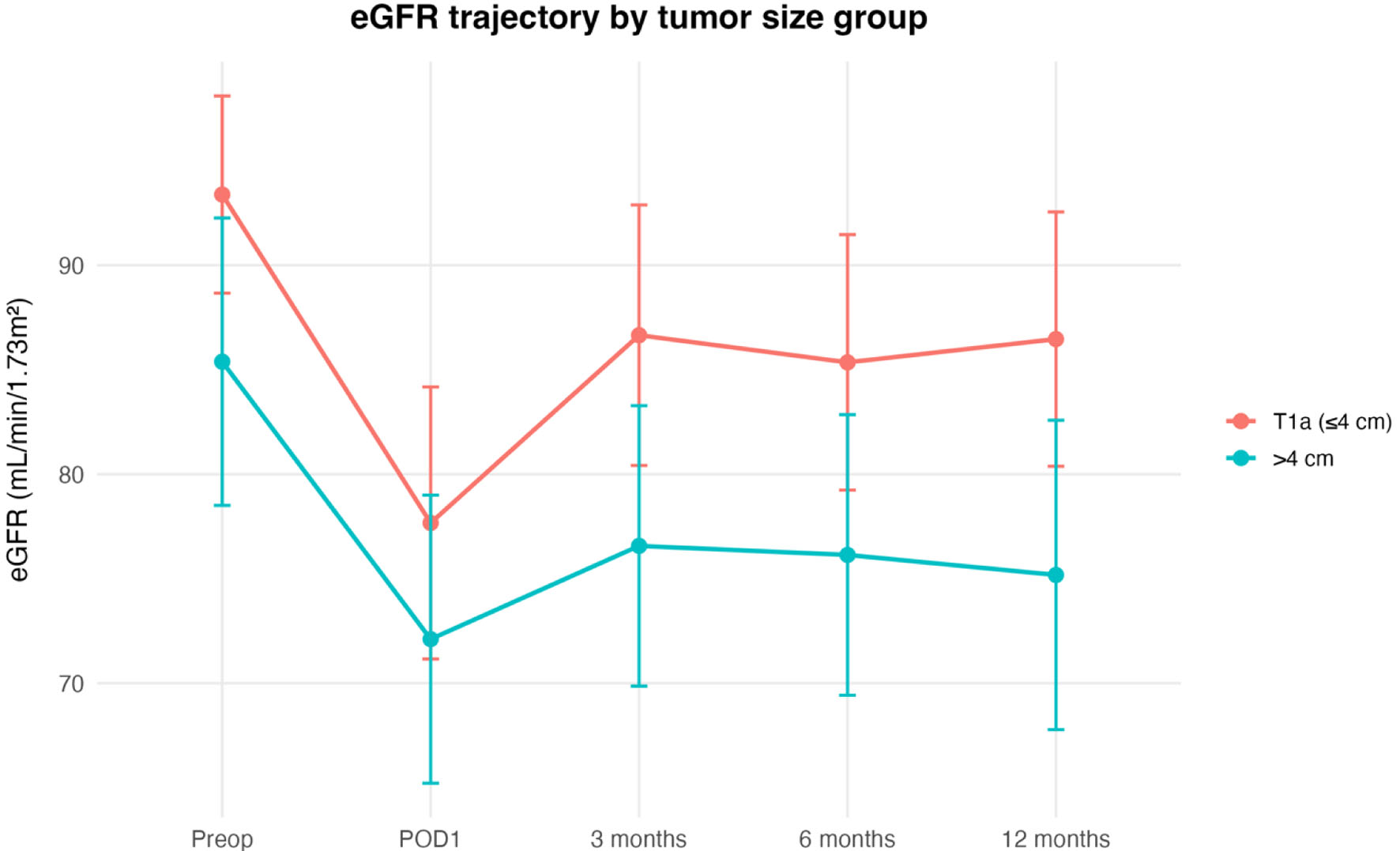
Results: Compared with the T1a group, patients with tumors > 4 cm had significantly higher RENAL scores and a greater proportion of highly complex tumors. Operative time was longer (252.1 vs. 226.3 min, P = 0.030), and hospital stay was longer (median 6 vs. 5 days, P = 0.040). No statistically significant differences were observed in warm ischemia time, estimated blood loss, complication rates, positive surgical margin rates, or trifecta achievement (43.8% vs. 50.0%, P = 0.765), although the study may have been underpowered to detect clinically meaningful differences. Absolute estimated glomerular filtration rate (eGFR) was lower in the > 4 cm group at 3, 6, and 12 months, but eGFR preservation percentages and chronic kidney disease (CKD) upstaging rates did not differ significantly. On exploratory multivariable analysis, tumor size > 4 cm was not independently associated with trifecta achievement (odds ratio (OR) 0.80, 95% confidence interval (CI) 0.28–2.26, P = 0.673), and no statistically significant independent predictor was identified.
Conclusions: RAPN for tumors > 4 cm was associated with greater anatomical complexity and modestly increased operative burden. No statistically significant differences were observed in ischemic, complication, oncologic, or relative renal functional outcomes, although these comparisons should be interpreted cautiously because the study may have been underpowered for uncommon events. These findings support the feasibility of RAPN for selected larger malignant renal tumors in a real-world single-center setting.
Published
Issue
Section
License
Copyright (c) 2026 The authors

This work is licensed under a Creative Commons Attribution 4.0 International License.