


Human Epidermal Growth Factor Receptor 2 Negative, Low, and Overexpression in Breast Cancer Patients: Study on Recurrence-Free and Overall Survival
DOI:
https://doi.org/10.14740/wjon2780Keywords:
Breast cancer, HER2 expression, HER2-low, Overall survival, Recurrence-free survival, PrognosisAbstract
Background: Human epidermal growth factor receptor 2 (HER2) expression is a key prognostic marker in breast cancer. Recently, HER2-low breast cancer has emerged as a potentially distinct subgroup; however, its prognostic significance remains controversial, particularly in real-world clinical settings. This study aimed to evaluate recurrence-free and overall survival (OS) across HER2 expression categories: HER2-negative, HER2-low, and HER2-overexpressing.
Methods: This observational analytic study used a retrospective cohort design conducted at Dr. Moewardi Hospital, a tertiary referral center in Central Java, Indonesia. A total of 2,310 breast cancer patients with complete HER2 immunohistochemistry (IHC) results and documented survival data from 2018 to 2020 were included. HER2 status was classified as HER2-negative (IHC 0), HER2-low (IHC 1+ or IHC 2+ without amplification), and HER2-overexpression (HER2-positive). The primary outcome was OS, defined as the time from diagnosis to death from any cause. Survival was analyzed using the Kaplan–Meier method, with comparisons by log-rank test and risk estimation using Cox proportional hazards regression.
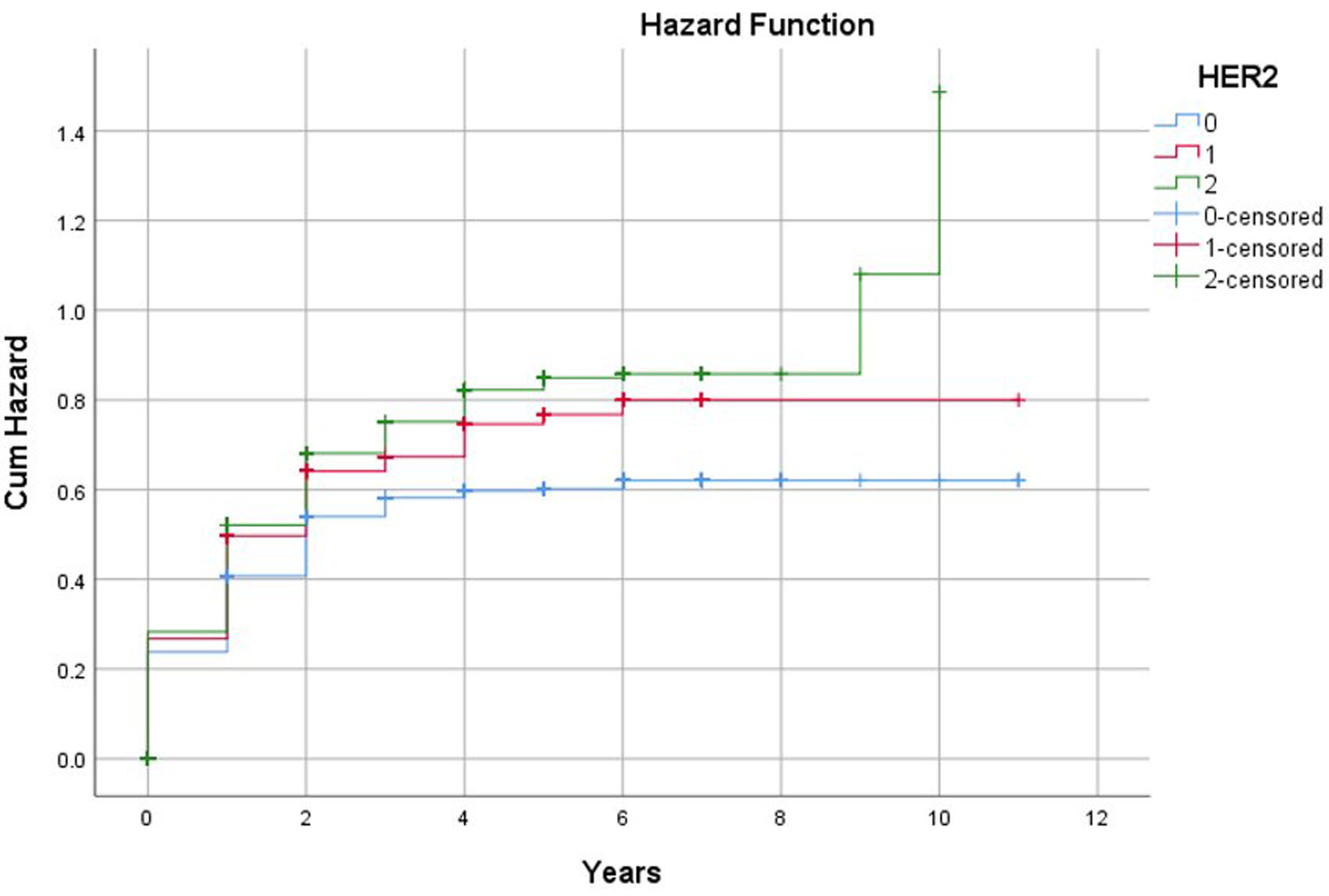
Results: Of the patients, 43.6% were HER2-negative, 21.3% HER2-low, and 35.2% HER2-overexpressing. Kaplan–Meier analysis showed significant differences in OS among groups (log-rank χ2 = 17.150; P < 0.001). HER2-negative patients had the best outcomes (mean OS 6.38 years; median unreached), followed by HER2-low (mean OS 5.60 years; median 4.00 years), and HER2-overexpression (mean OS 4.80 years; median 3.00 years). Significant differences were observed between HER2-negative vs. HER2-low (P = 0.015) and HER2-negative vs. HER2-overexpression (P < 0.001), but not between HER2-low and HER2-overexpression (P = 0.356). In Cox analysis, HER2-negative status reduced mortality risk by 22.2% compared with HER2-overexpression (hazard ratio 0.778; 95% confidence interval, 0.679–0.892; P < 0.001), while HER2-low showed no significant difference (hazard ratio 0.935; P = 0.413).
Conclusions: HER2 expression is a significant prognostic factor in breast cancer. HER2-low patients have worse survival than HER2-negative patients and outcomes comparable to HER2-overexpression. These findings suggest that HER2-low breast cancer should not be considered low-risk and have important implications for prognostic stratification and treatment planning.
Published
Issue
Section
License
Copyright (c) 2026 The authors

This work is licensed under a Creative Commons Attribution 4.0 International License.