Exploring the Association Between Colorectal Cancer Metastasis and Metabolic Dysfunction-Associated Steatotic Liver Disease: A Nationwide Analysis
DOI:
https://doi.org/10.14740/wjon2809Keywords:
Colorectal cancer, Colorectal cancer metastasis, Metabolic dysfunction-associated steatotic liver disease, Hospital outcomes, National Inpatient SampleAbstract
Background: Metabolic syndrome-associated conditions and malignancies frequently co-exist, influencing each other’s progression, severity, and prognosis. This study evaluates whether metabolic dysfunction-associated steatotic liver disease (MASLD) contributes to an increased risk of colorectal cancer (CRC) metastasis and in-hospital mortality using a large nationally representative database.
Methods: We analyzed data from the National Inpatient Sample (NIS) database (2016 to 2020), identifying adult hospitalizations with CRC and then stratified the total population by the presence or absence of MASLD. Outcomes assessed included total CRC metastases, site-specific metastasis (such as gastrointestinal (GI) metastasis, liver metastasis, non-GI metastasis, lymphoid metastasis), and in-hospital mortality. Multivariate logistic regression model was used to adjust for patient demographics, comorbidities, and hospital characteristics. A subgroup analysis was performed to assess the association of MASLD and liver metastasis due to differences in sex, age, and race.
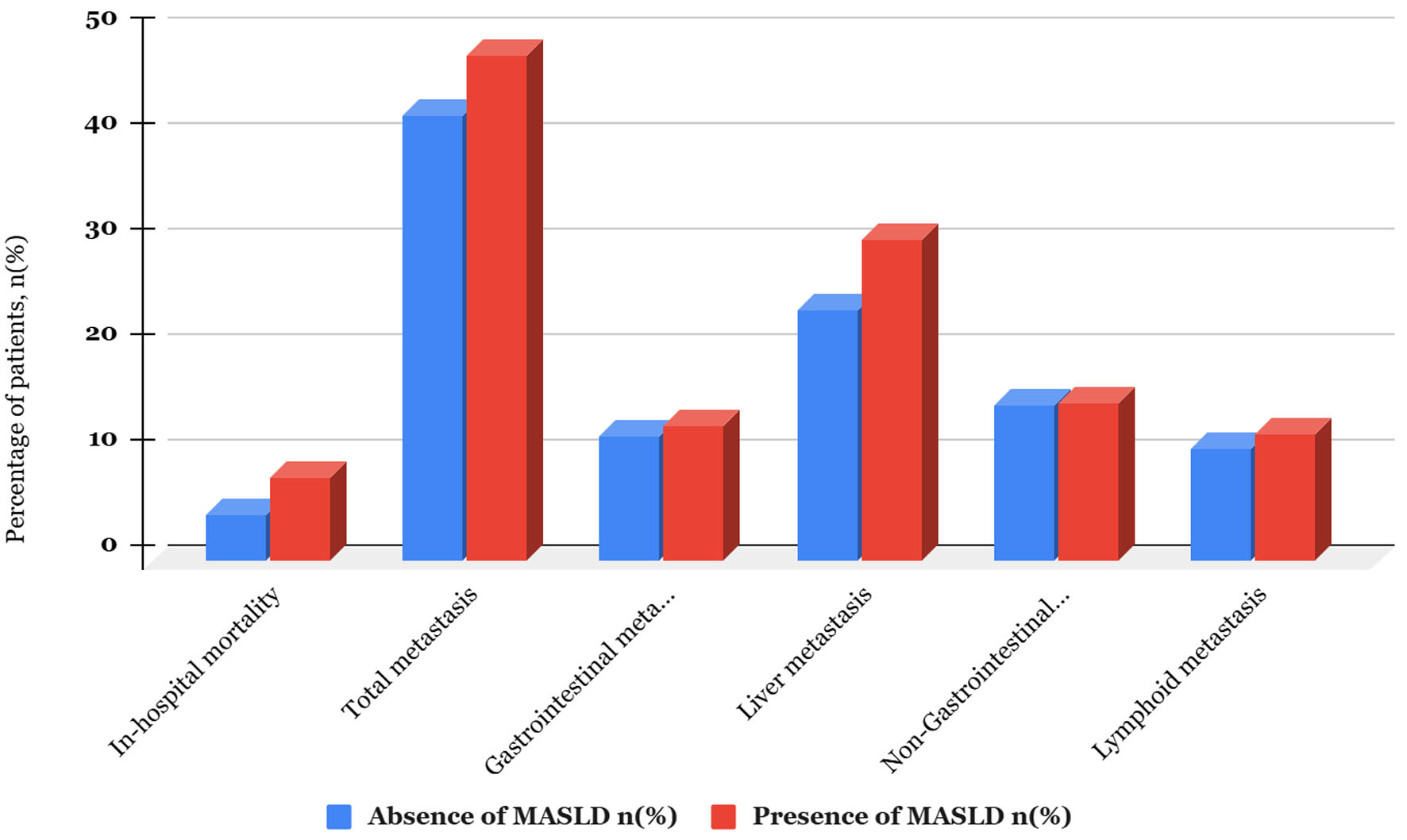
Results: Among 814,270 hospitalizations with CRC, 35,595 (4.4%) had concurrent MASLD diagnosis. Hospitalizations with MASLD had a significantly higher prevalence of total metastasis (47.9% vs. 42.2%), liver metastasis (30.5% vs. 23.8%), GI metastasis (12.8% vs. 11.8%), and lymphoid metastasis (11.9% vs. 10.6%). Multivariate analysis also showed that MASLD was independently associated with higher odds of liver metastasis (adjusted odds ratio (aOR) 1.38, 95% confidence interval (CI) 1.31–1.46), total metastasis (aOR 1.24, 95% CI 1.18–1.30), GI metastasis (aOR 1.08, 95% CI 1.00–1.16), and lymphoid metastasis (aOR 1.12, 95% CI 1.04–1.21). Analysis also revealed an increased odds of in-hospital mortality (aOR 1.85, 95% CI 1.68–2.03) among hospitalizations with MASLD. The association of MASLD with liver metastasis was consistent across sex, age, and race.
Conclusion: MASLD is significantly associated with metastatic CRC, especially liver metastasis, and increased in-hospital mortality. These findings support the need for increased surveillance and effective treatment for concurrent MASLD in patients with CRC.
Published
Issue
Section
License
Copyright (c) 2026 The authors

This work is licensed under a Creative Commons Attribution 4.0 International License.