


De-Escalation of Axillary Surgery: A Review of Choosing Wisely Guideline Evidence
DOI:
https://doi.org/10.14740/wjon2710Keywords:
Breast cancer, Lymph nodes, De-escalation, Omission, Sentinel lymph node biopsy, Choosing WiselyAbstract
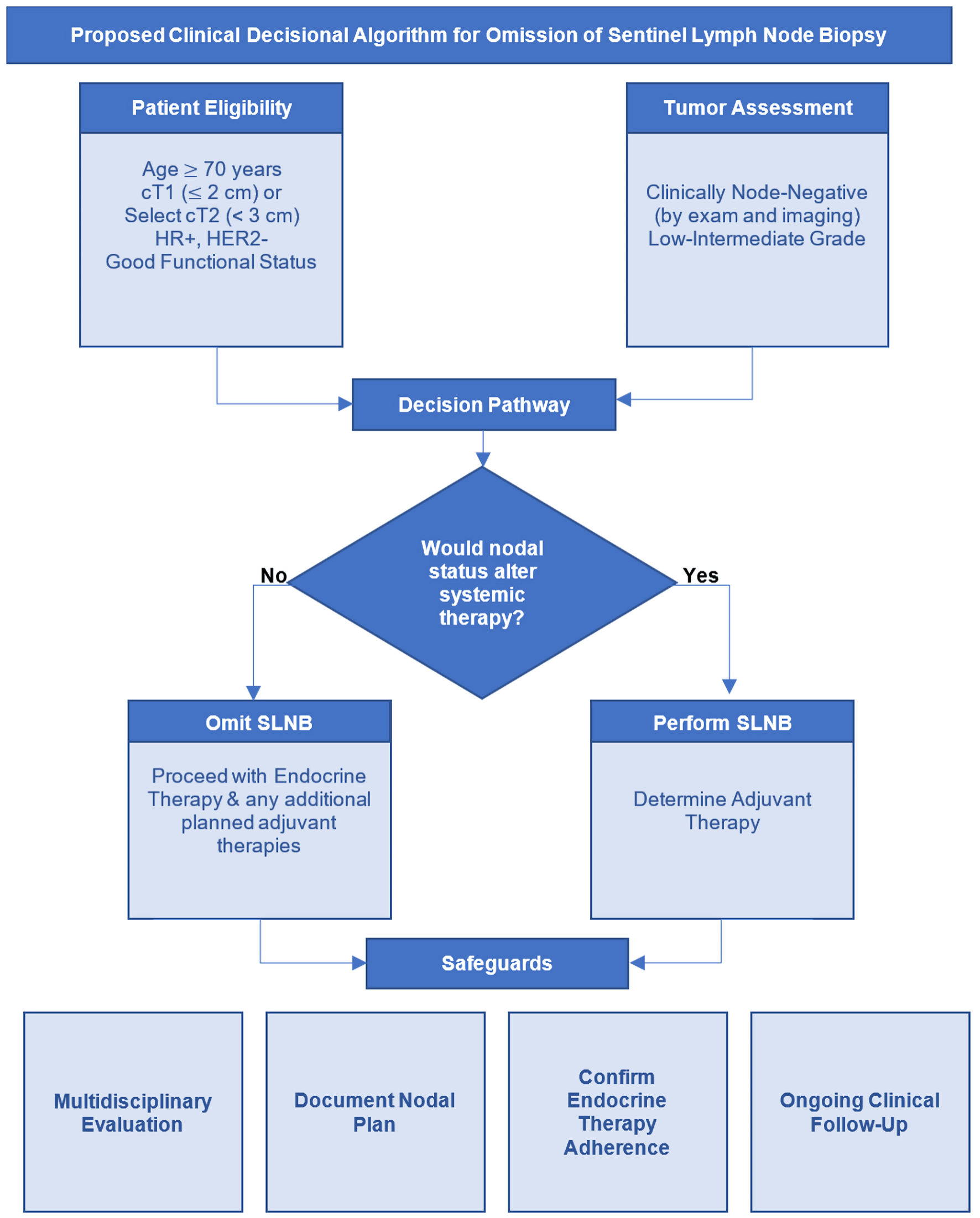
Management of the axilla in early stage breast cancer has shifted toward less invasive approaches as evidence demonstrates equivalent oncologic outcomes with reduced morbidity. In older women with biologically favorable disease, the value of axillary staging has been increasingly questioned. This review outlines the evolution of axillary surgery from axillary lymph node dissection to sentinel lymph node biopsy and subsequent omission strategies. We synthesize the available evidence presented defining when omission of sentinel lymph node biopsy is safe and how it can be implemented in practice. The Society of Surgical Oncology 2016 Choosing Wisely® guideline advises against routine sentinel lymph node biopsy in women ≥ 70 years with clinically node-negative, hormone receptor-positive/human epidermal growth factor receptor 2 (HER2)-negative invasive breast cancer receiving endocrine therapy. Across studies, omission of sentinel lymph node biopsy in appropriately selected patients is associated with low axillary recurrence rates without compromise in disease-free, breast cancer-specific, or overall survival. Although regional recurrence is modestly increased without axillary staging, these events are uncommon and typically amenable to salvage therapy. Despite strong evidence and professional endorsement, implementation of this recommendation remains inconsistent, with persistently high utilization of sentinel lymph node biopsy among women eligible for omission. Contemporary data indicate that adjuvant therapy decisions in hormone receptor-positive disease are driven primarily by tumor biology, with nodal status altering management in a minority of postmenopausal women. We propose a structured clinical decision framework incorporating tumor biology, physiologic rather than chronological age, competing mortality risk, and planned endocrine therapy. When nodal status is unlikely to influence treatment, omission of sentinel lymph node biopsy is a safe, evidence-based refinement that reduces morbidity without compromising survival. Multidisciplinary coordination is essential to optimize adjuvant therapy while minimizing low-value surgical care.
Published
Issue
Section
License
Copyright (c) 2026 The authors

This work is licensed under a Creative Commons Attribution 4.0 International License.