


Characterization of Acute Myeloid Leukemia With t(16;21) Translocation: Cytogenetic, Molecular, and Immunophenotypic Findings
DOI:
https://doi.org/10.14740/wjon2700Keywords:
Leukemia myeloid acute, Core binding factors, RUNX1 translocation partner 1 protein, TLS-ERG fusion protein human, PrognosisAbstract
Background: Acute myeloid leukemia (AML) with t(16;21) translocation is an infrequent hematological neoplasia. This study aimed to describe the cytogenetic, molecular and immunophenotypic profiles of this disease.
Methods: We conducted a descriptive observational study using secondary data. AML cases with the t(16;21) translocation were identified from the Mitelman database and systematic searches in PubMed, Scopus, SciELO and Genetics and Cytogenetics in Oncology and Hematology databases. Cytogenetic, molecular, immunophenotypic and clinical variables were extracted. We performed descriptive and survival statistical analyses at 2 and 5 years.
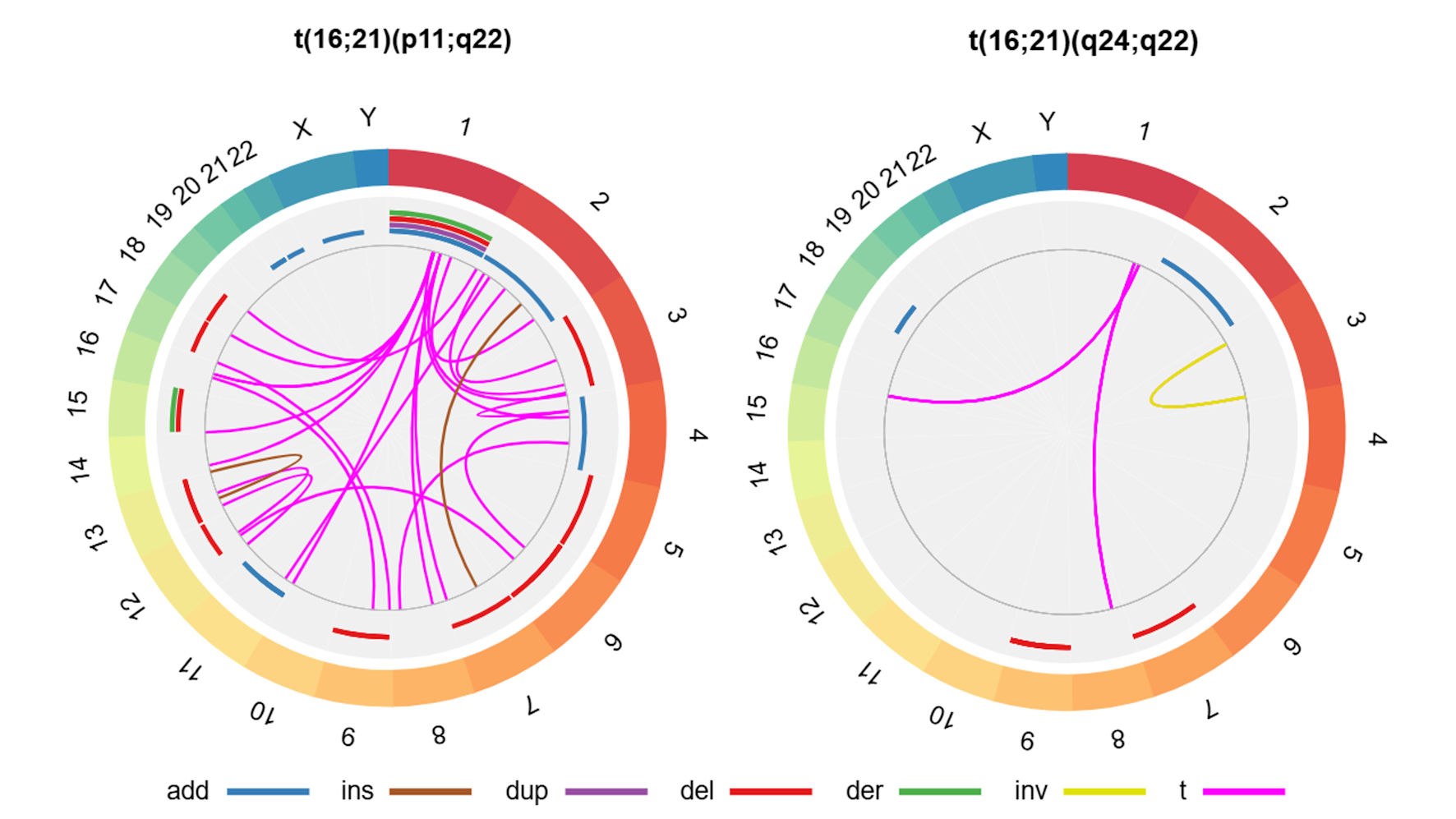
Results: We identified 103 cases with AML with t(16;21). Most cases were t(16;21)(p11;q22) (n = 90, 87.4%), with recurrent additional abnormalities including +10 (14.4%), –16 (7.8%), add(11) (5.6%), and del(6) (4.4%), while t(16;21)(q24;q22) cases mainly showed +8 (45.5%) and del(9) (18.2%). FUS::ERG was reported in 62.2% of t(16;21)(p11;q22) cases, whereas RUNX1::RUNX1T3 was detected in 72.2% of t(16;21)(q24;q22). Immunophenotypically, t(16;21)(p11;q22) cases expressed (among the cases evaluated) cluster of differentiation (CD)13 (100%), CD33 (96.6%), CD34 (98.0%), CD56 (93.0%), and MPO (84.8%), while all evaluated t(16;21)(q24;q22) cases were positive for CD13, CD33, CD34, and MPO. Relapse information was missing for a substantial proportion of cases; among those with available data (65.0%), relapse occurred in 51 cases (76.1%). The 5-year mortality rate was significantly higher in the t(16;21)(p11;q22) group than in the t(16;21)(q24;q22) group (P = 0.012), with no significant difference at 2 years.
Conclusions: The cytogenetic, molecular, and immunophenotypic characteristics of AML with t(16;21) vary according to the chromosomal breakpoint. The t(16;21)(p11;q22) translocation was the most frequently reported and was frequently associated with CD56 expression. The findings suggest that patients with t(16;21)(p11;q22) exhibited lower 5-year survival compared with the other group, highlighting the unfavorable outcomes observed in reported cases.
Published
Issue
Section
License
Copyright (c) 2026 The authors

This work is licensed under a Creative Commons Attribution 4.0 International License.