


Integrated Bioinformatics Analysis Identifies NCAPG2 as an Immune-Related Prognostic Biomarker in Breast Cancer
DOI:
https://doi.org/10.14740/wjon2768Keywords:
Bioinformatics analysis, Prognosis predicting, Breast cancer, Non-SMC condensin II complex subunit G2, Immune infiltrationAbstract
Background: Non-SMC condensin II complex subunit G2 (NCAPG2) is an important molecule in regulating chromosome segregation of mitosis and acts as an oncogene and biomarker in various tumors. This study aimed to explore the role of NCAPG2 in breast cancer (BC).
Methods: The mRNA and protein expression of NCAPG2 was explored in the Gene Expression Profiling Interactive Analysis (GEPIA), Tumor Immune Estimation Resource (TIMER), Human Protein Atlas (HPA), and bc-GenExMiner databases. Survival analyses were performed using the Kaplan–Meier plotter and bc-GenExMiner databases. We used the COSMIC, CistromeDB, and cBioPortal databases to analyze the transcriptional regulation and genetic alteration. Function enrichment analyses were performed with CancerSEA and Metascape database.
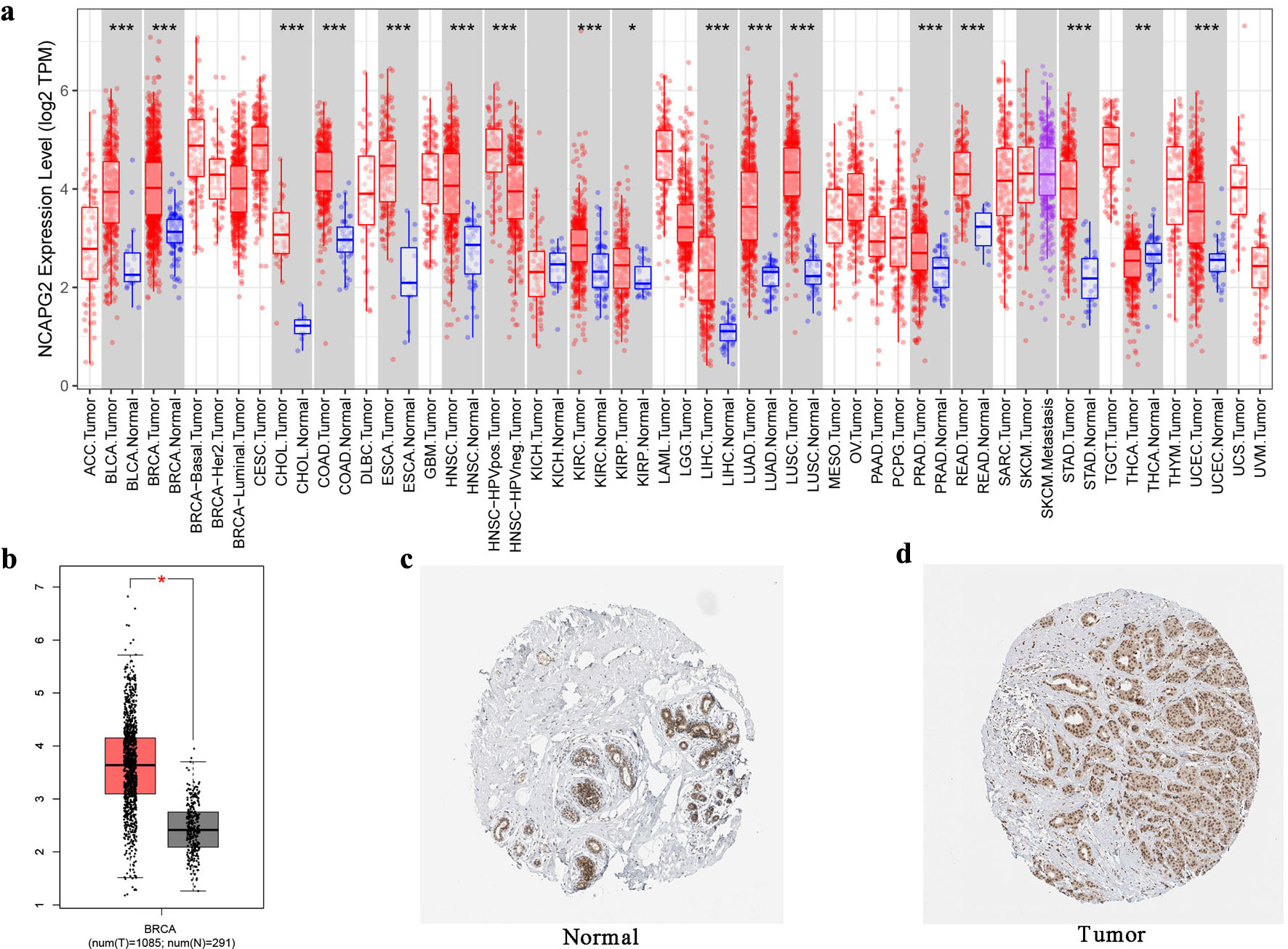
Results: NCAPG2 expression was significantly higher in BC than normal samples. NCAPG2 expression was positively correlated with the Scarff–Bloom–Richardson (SBR) grade, HER2 status, lymph nodal status, TP53 and BRCA1/2 mutation, and Nottingham prognostic index (NPI), while negatively correlated with age, ER status, and PR status. Survival analyses indicated that overexpressed NCAPG2 was associated with the adverse prognosis of BC. Gene Set Enrichment Analysis (GSEA) and function enrichment analyses of single-cell and co-expressed genes of NCAPG2 consistently showed that NCAPG2 was involved in cell cycle, immune, DNA damage, cancer-related pathways, proliferation, and DNA repair. The result of TIMER showed that NCAPG2 was associated with infiltrating immune cells and the exhausted T cell phenotype, such as CD8+ T cells, PD-1, CTLA4, and TIM-3.
Conclusion:: We found that the mRNA and protein expression of NCAPG2 was upregulated in BC. Overexpressed NCAPG2 might act as an adverse prognosis biomarker in BRCA and had a distinct function in the cell cycle, proliferation, and immune infiltration.
Published
Issue
Section
License
Copyright (c) 2026 The authors

This work is licensed under a Creative Commons Attribution 4.0 International License.