

Development of a Computational Histology Artificial Intelligence-Powered Prognostic Biomarker in Colorectal Cancer in The Cancer Genome Atlas
DOI:
https://doi.org/10.14740/wjon2823Keywords:
Colorectal cancer, Artificial intelligence, Computational pathology, Biomarker, Prognostic, TCGA, HistopathologyAbstract
Background: Risk stratification in colorectal cancer (CRC) plays an important role in treatment decision-making. As such, prognostic biomarkers that can augment risk stratification have clinical value. Quantitative histologic features from routine hematoxylin and eosin (H&E)-stained whole slide images (WSIs) provide a novel avenue for biomarker discovery. In this study, we explored the potential for a computational histology artificial intelligence (CHAI) platform to develop and validate a prognostic biomarker in CRC.
Methods: The Cancer Genome Atlas Colorectal Adenocarcinoma project was utilized for this study, with inclusion of all subjects (stage I–IV) with available digitized H&E specimens. The cohort was split into development and validation cohorts by a stratified random split. The previously developed CHAI platform was applied in the development cohort to construct a continuous risk score from histologic features associated with progression-free interval (PFI) that was dichotomized based on an optimized cutpoint for distinguishing PFI into a high risk CHAI (+) and lower risk CHAI (–). PFI was compared between CHAI (+) and CHAI (–) patients in the validation cohort in multivariable Cox proportional hazards models. Time-dependent area under the curve (tdAUC) and C-indices were also calculated for PFI.
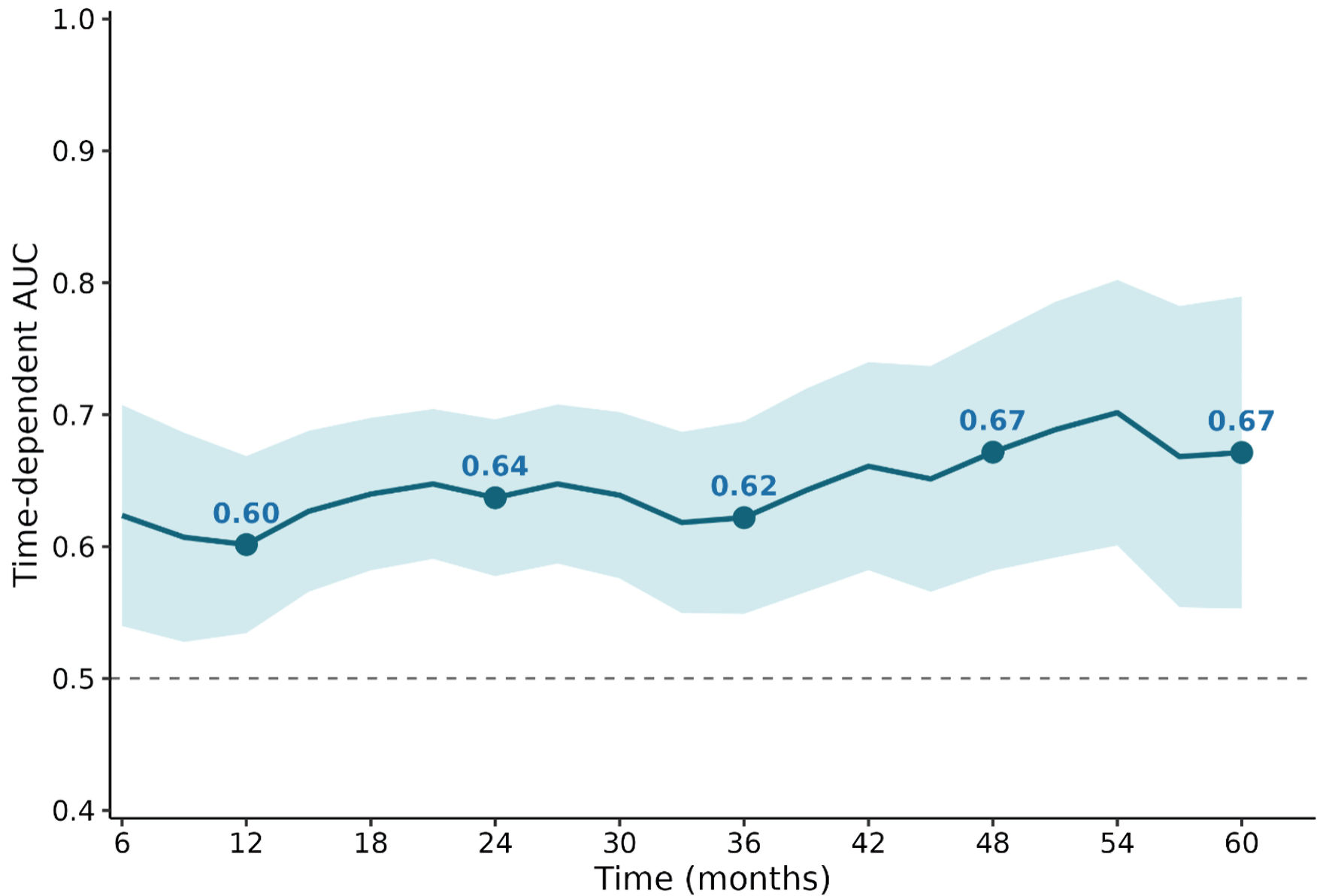
Results: A total of 583 participants were included in the study, with 409 assigned to the validation cohort. The CHAI biomarker classified 229 participants (56%) as CHAI (+) and 180 (44%) as CHAI (–) in the validation set. CHAI (+) participants had worse PFI in a multivariable analysis adjusting for available clinicopathologic variables (hazard ratio (HR) = 2.65; 95% confidence interval (CI), 1.63–4.30). TdAUC for the CHAI biomarker was 0.60 (95% CI, 0.53–0.67) at 12 months, 0.62 (0.55–0.69) at 36 months, and 0.67 (0.55–0.79) at 60 months; the C-index was 0.62 (95% CI, 0.58–0.67).
Conclusions: The CHAI platform was used to develop a prognostic digital pathology biomarker in CRC. This demonstrates the feasibility and potential to apply this artificial intelligence-based digital pathology biomarker platform for risk stratification in CRC and supports its further study.
Published
Issue
Section
License
Copyright (c) 2026 The authors

This work is licensed under a Creative Commons Attribution 4.0 International License.