


Impact of Molecular and Cytogenetic Risk Stratification, Early Treatment Response, and Inflammatory Biomarkers on Survival in Intensively Treated Non-Acute Promyelocytic Leukemia Acute Myeloid Leukemia
DOI:
https://doi.org/10.14740/wjon2856Keywords:
Acute myeloid leukemia, ELN risk stratification, Overall survival, Complete remission, Neutrophil-to-lymphocyte ratio, Kaplan–Meier analysis, Induction chemotherapyAbstract
Background: Acute myeloid leukemia (AML) is a clinically and molecular heterogeneous hematologic malignancy with highly variable treatment outcomes. The European Leukemia Net (ELN) 2022 classification integrates cytogenetic and molecular abnormalities to guide risk stratification and therapeutic decision making; however, real-world prognostic data from resource-limited settings remain limited. This study evaluated the impact of ELN 2022 molecular and cytogenetic risk stratification, early treatment response, and inflammatory biomarkers on remission and survival among intensively treated adults with non-acute promyelocytic leukemia (non-APL) AML.
Methods: This retrospective single-center cohort study included 90 adults with newly diagnosed non-APL AML who received intensive induction chemotherapy. Patients were stratified according to the ELN 2022 classification into favorable (n = 10), intermediate (n = 67), and adverse (n = 13) risk groups. The primary outcomes were complete remission (CR), overall survival (OS), and event-free survival (EFS). Survival analyses were performed using the Kaplan–Meier method and Cox proportional hazards regression, while logistic regression was used to identify predictors of CR. Baseline inflammatory indices, including the neutrophil-to-lymphocyte ratio (NLR), platelet-to-lymphocyte ratio (PLR), monocyte-to-lymphocyte ratio (MLR), and Prognostic Nutritional Index (PNI), were evaluated as exploratory prognostic biomarkers.
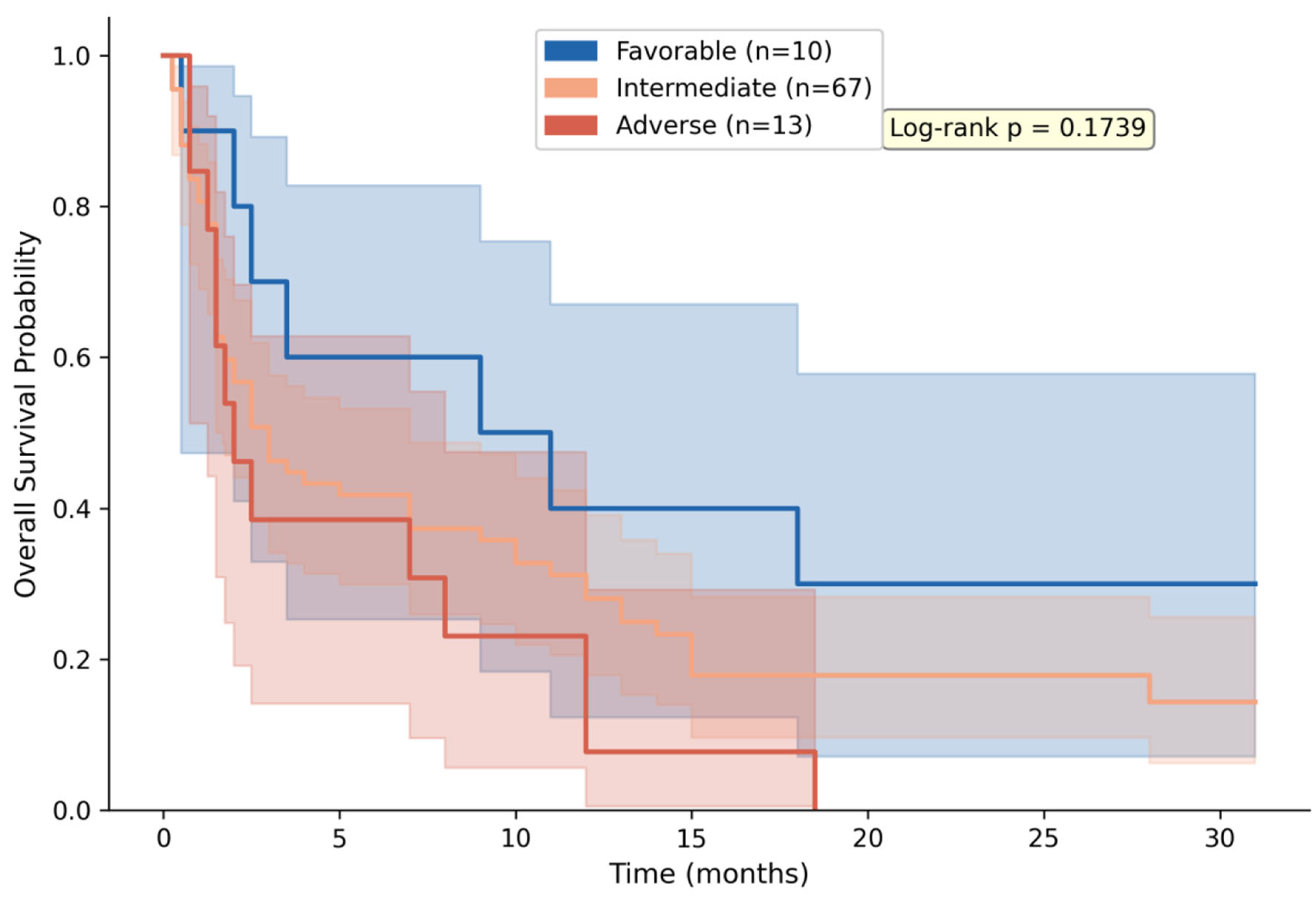
Results: CR was achieved in 53 patients (58.9%), whereas induction-related mortality occurred in 15 patients (16.7%). Median OS for the entire cohort was 3.0 months (interquartile range, 1.5–12.8 months). Day 28 induction response was the strongest independent predictor of OS (hazard ratio (HR), 4.81; 95% confidence interval (CI), 2.98–7.75; P < 0.001). Higher log-transformed NLR was independently associated with improved OS (HR, 0.56; 95% CI, 0.38–0.82; P = 0.003). Given the retrospective design, this NLR association should be regarded as an exploratory, hypothesis-generating observation rather than a confirmed protective effect. Although favorable-risk patients demonstrated longer median OS than intermediate- and adverse-risk patients (9.0, 3.0, and 2.0 months, respectively), differences among ELN risk groups were not statistically significant. Minimal residual disease negativity was achieved in 90.6% of patients who attained CR.
Conclusions: In this real-world cohort of intensively treated adults with non-APL AML, day 28 induction response was the strongest independent predictor of survival. Although ELN 2022 risk stratification demonstrated clinically meaningful survival trends, it did not independently predict outcomes after multivariable adjustment, possibly reflecting the limited sample size and incomplete molecular profiling. Baseline NLR may provide complementary prognostic information and represent an inexpensive, readily available biomarker that merits further prospective validation. This association should be regarded as exploratory and may in part reflect unmeasured confounding by nutritional and immune status rather than a confirmed causal effect.
Published
Issue
Section
License
Copyright (c) 2026 The authors

This work is licensed under a Creative Commons Attribution 4.0 International License.