

RAD51 in Breast Cancer: From Vulnerability to Resistance
DOI:
https://doi.org/10.14740/wjon2764Keywords:
RAD51, BRCA2, Homologous recombination, Replication fork, Breast cancerAbstract
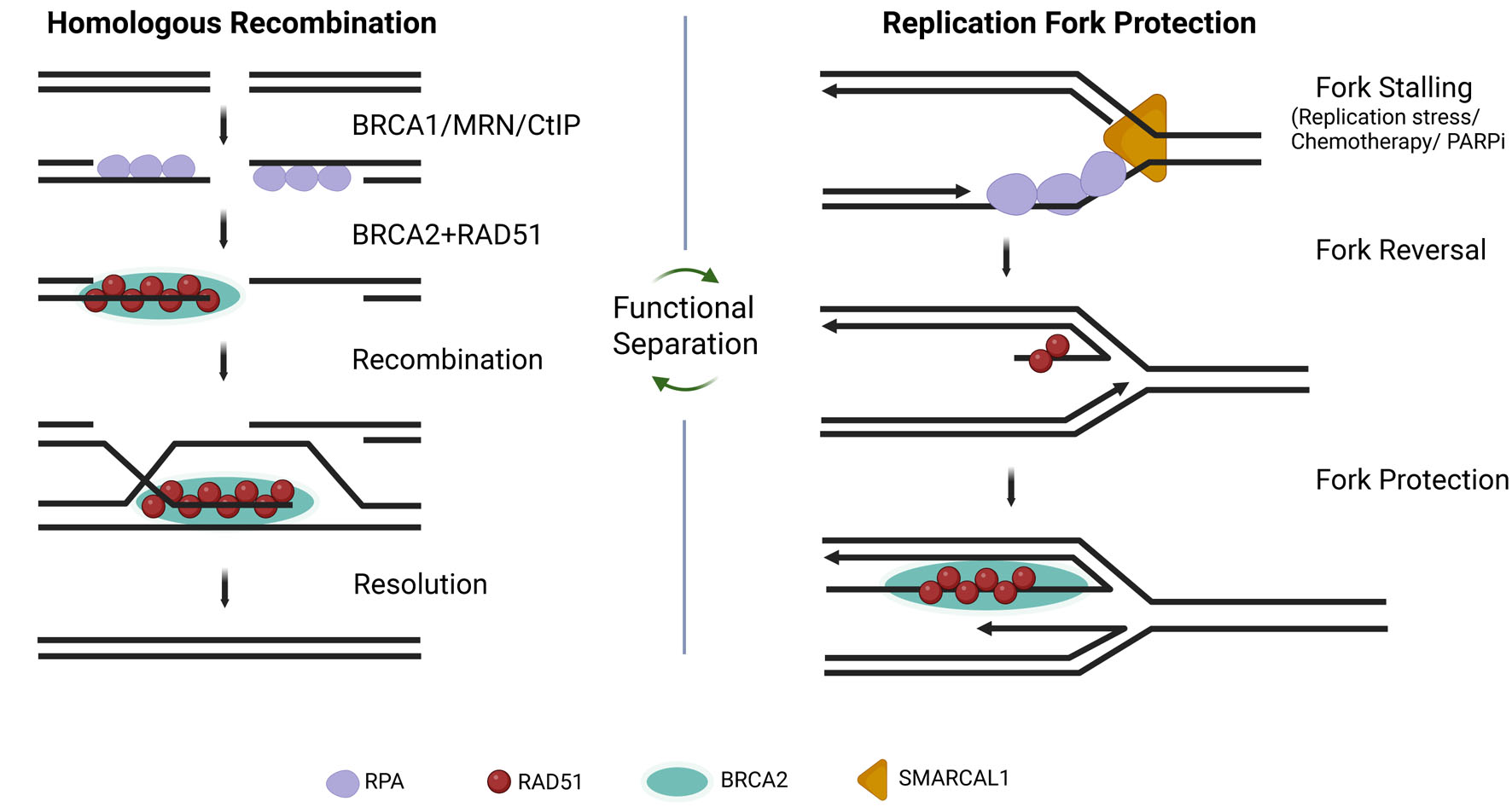
Homologous recombination deficiency (HRD) has transformed the therapeutic landscape of breast cancer through the clinical success of poly(ADP-ribose) polymerase (PARP) inhibitors and platinum-based chemotherapy. Central to this vulnerability is radiation sensitivity 51 (RAD51), the recombinase that executes homologous DNA repair and stabilizes stalled replication forks. In breast cancer susceptibility type 1 (BRCA1)- and breast cancer susceptibility type 2 (BRCA2)-mutant tumors, impaired RAD51 loading produces profound sensitivity to DNA-damaging agents. However, accumulating evidence indicates that restoration of RAD51 function—particularly its role in replication fork protection—is an important mechanism underlying therapeutic resistance. Beyond its canonical role in strand exchange–mediated double-strand break (DSB) repair, RAD51 orchestrates replication fork reversal, stabilization, and restart under conditions of oncogene-driven replication stress. These fork-associated functions can be mechanistically separable from classical homologous recombination and may be sufficient to confer resistance to PARP inhibitors even in tumors with persistent genomic scar signatures. Thus, breast cancer evolution under therapeutic pressure can be conceptualized as a transition from RAD51 deficiency–driven vulnerability to RAD51-dependent adaptive survival. In this review, we integrate structural, mechanistic, and translational insights into RAD51 biology and propose a dynamic framework in which replication fork protection represents a central adaptive axis in resistant breast cancer. We discuss functional biomarkers of RAD51 activity, subtype-specific dependency patterns, and emerging strategies to therapeutically target RAD51 in PARP inhibitor–refractory and replication stress–high disease. Understanding when RAD51 is deficient and when it becomes indispensable will be critical for refining precision oncology approaches in breast cancer. We argue that future precision oncology strategies must move beyond static HRD classification toward dynamic assessment of RAD51-dependent replication stress tolerance.
Published
Issue
Section
License
Copyright (c) 2026 The authors

This work is licensed under a Creative Commons Attribution 4.0 International License.