


The Development of Breast Apocrine Carcinoma Score That Distinguishes Breast and Cutaneous Apocrine Carcinomas
DOI:
https://doi.org/10.14740/wjon2869Keywords:
Breast apocrine carcinoma, Cutaneous apocrine carcinoma, Differentiation, Transcriptome, Discrimination scoreAbstract
Background: Apocrine carcinoma (AC) is a rare cancer that arises either from cutaneous apocrine sweat glands (cutaneous AC) or as breast carcinoma with apocrine differentiation (breast AC). Differentiation between them is clinically critical because their management and outcomes differ significantly: breast AC is treated according to established breast cancer therapies, whereas cutaneous AC lacks standardized systemic treatment and often carries a poorer prognosis. A diagnostic challenge arises when AC occurs in the axilla, where both entities may arise, given their highly similar histology.
Methods: In this study, we performed a retrospective multi-cohort transcriptomic analysis integrating institutional, multi-institutional, and publicly available datasets to characterize the molecular differences between breast and cutaneous ACs and developed a transcriptomic classifier using differentially expressed genes and a least absolute shrinkage and selection operator (LASSO) logistic regression model for tissue-of-origin classification.
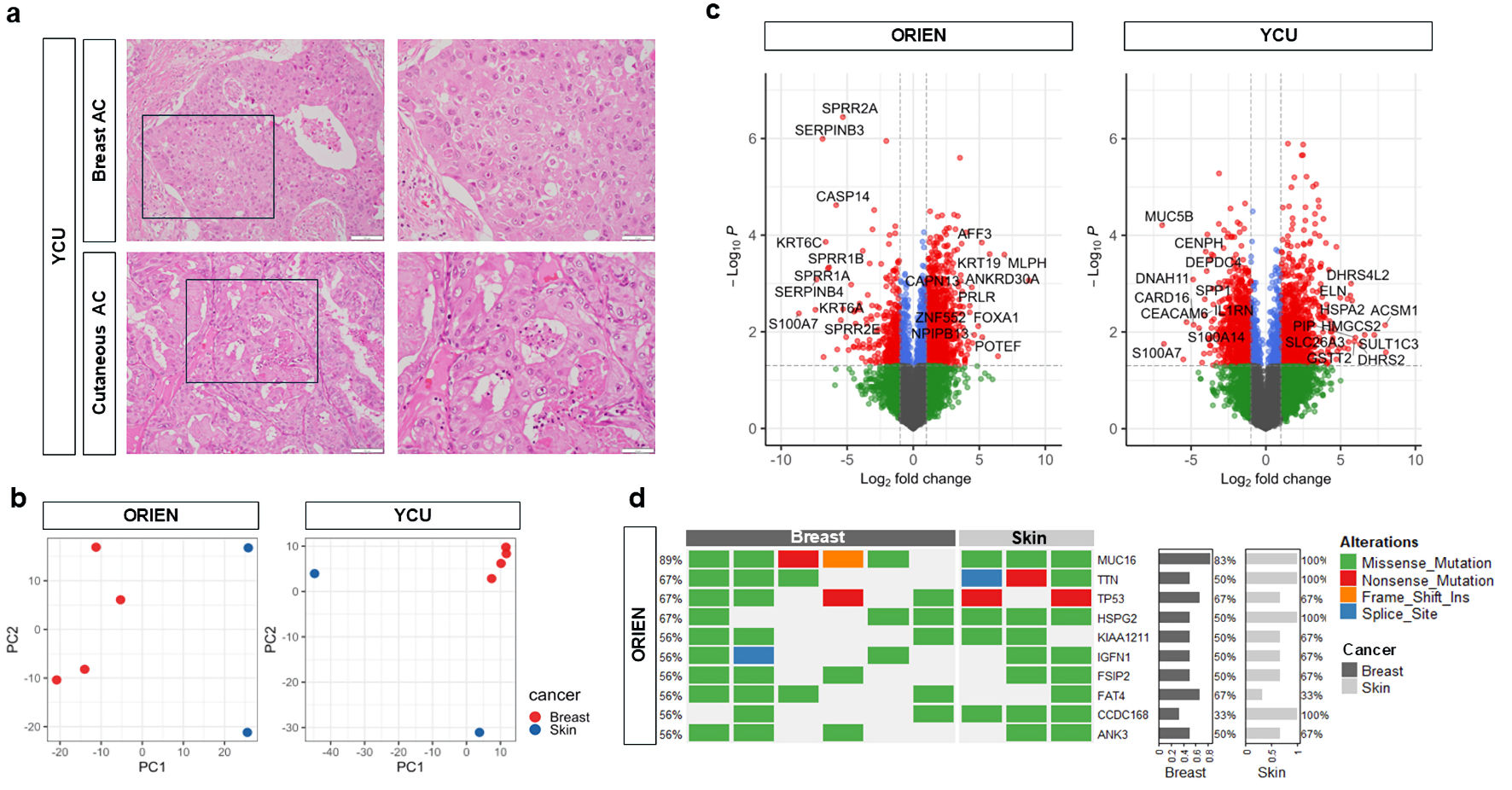
Results: Transcriptomic profiling revealed that breast ACs exhibited higher steroid hormone–related signaling and lower proliferative activity compared with cutaneous ACs, while immune-related features were largely comparable between the two tumor types. These findings suggest that, despite shared apocrine morphology, breast and cutaneous ACs retain distinct biological characteristics reflective of their tissue of origin. Building on this, we further developed a transcriptomic classifier, the Breast Apocrine Carcinoma (BAC) score, which distinguished breast and cutaneous ACs, suggesting that these tumors retain distinct tissue-of-origin transcriptional signatures despite shared apocrine differentiation. Furthermore, application of the BAC score to tumors with unknown primary origin in the axillary region enabled estimation of tissue origin, highlighting its potential clinical utility in diagnostically challenging cases.
Conclusions: Breast and cutaneous ACs exhibit distinct biological features despite shared apocrine morphology. The BAC score showed promising discriminatory ability for tumors of breast and cutaneous origin, including within AC cohorts, highlighting the potential utility of transcriptomic profiling for improving their classification and diagnostic evaluation.
Published
Issue
Section
License
Copyright (c) 2026 The authors

This work is licensed under a Creative Commons Attribution 4.0 International License.