


Dysregulated Serum miR-222-3p, miR-595, and miR-130a-3p as Potential Noninvasive Diagnostic Biomarkers for Papillary Thyroid Carcinoma
DOI:
https://doi.org/10.14740/wjon2858Keywords:
hsa-miR-222-3p, hsa-miR-595, hsa-miR-130a-3p, Papillary thyroid carcinomaAbstract
Background: Thyroid cancer is the most common malignancy in the endocrine system, with an annual incidence growing faster than nearly any other cancer. Papillary thyroid carcinoma (PTC) represents the most prevalent subtype of thyroid cancer. Accumulating evidence indicates that specific microRNAs (miRNAs) are consistently dysregulated in PTC. This study aimed to evaluate differentially expressed miRNAs in serum, which might become potential biomarkers for the diagnosis of PTC.
Methods: A total of 75 PTC patients attending the Smart Health Tower in Sulaymaniyah City and 55 healthy controls (HCs) from June 2024 and May 2025 were enrolled in this case-control study. Reverse transcription-quantitative polymerase chain reaction (RT-qPCR) was used to measure the serum levels of certain miRNAs (hsa-miR-222-3p, hsa-miR-595, and hsa-miR-130a-3p), with U6 serving as the internal reference. Using receiver operating characteristic (ROC) curve analysis, the diagnostic performance was determined.
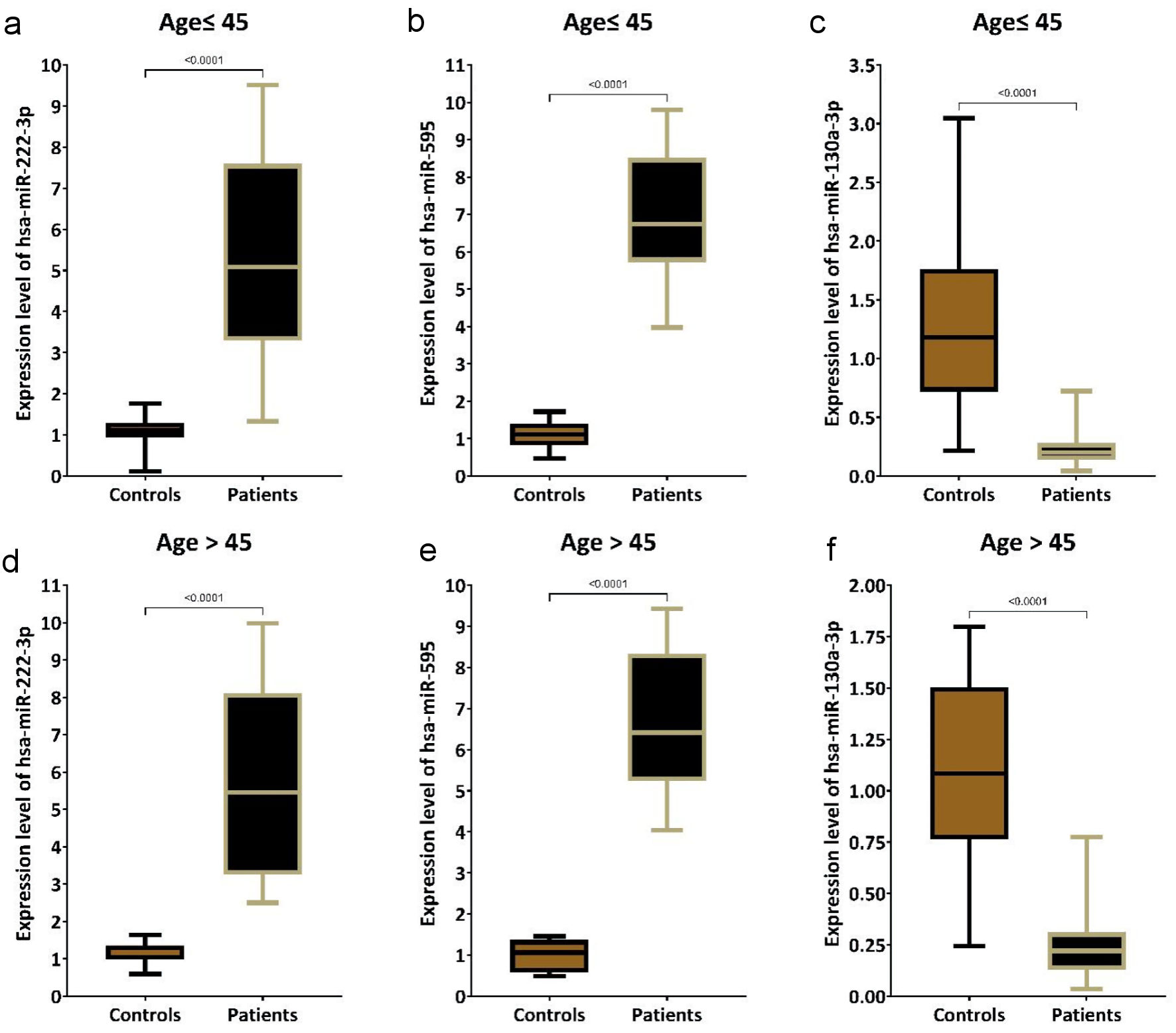
Results: Three miRNAs presented significant dysregulation in PTC patients when compared with HC individuals (P < 0.0001). The miR-222-3p and miR-595 expression levels were upregulated with approximately 5-fold and 6.5-fold, respectively. Conversely, the miR-130a-3p expression level was downregulated by approximately 5-fold. ROC curve analysis demonstrated exceptional diagnostic value: miR-222-3p achieved an area under the curve (AUC) of 0.996 (95% confidence interval (CI), 0.994–0.999) with 98% sensitivity and 100% specificity; miR-595 showed an AUC of 0.970 (95% CI, 0.901–0.996) with 92% sensitivity and 96% specificity; and miR-130a-3p exhibited an AUC of 0.939 (95% CI: 0.600–0.900) with 92% sensitivity and 88% specificity. Similar expression patterns were identified across PTC, and the diagnostic performance remained consistent across all age and gender subgroups. Nonetheless, no statistically significant correlations between clinicopathological characteristics and miRNA expression were found.
Conclusions: Circulating serum levels of miR-222-3p, miR-595, and miR-130a-3p might serve as noninvasive diagnostic biomarkers for PTC. Elevated expression levels of miR-222-3p and miR-595 implicate an oncogenic role, whereas reduced levels of miR-130a-3p indicate a tumor-suppressive function in thyroid carcinogenesis. miRNAs could be essential molecular biomarkers for PTC diagnosis when applied in serum.
Published
Issue
Section
License
Copyright (c) 2026 The authors

This work is licensed under a Creative Commons Attribution 4.0 International License.