


Tumor Marker Heterogeneity in Ovarian Cancer: Clinical Implications of Pretreatment Monitoring of Serum Biomarkers for Recurrence Prediction
DOI:
https://doi.org/10.14740/wjon2800Keywords:
Ovarian cancer, CA-125, Carcinoembryonic antigen, Lactate dehydrogenase, Pretreatment biomarkers, PrognosisAbstract
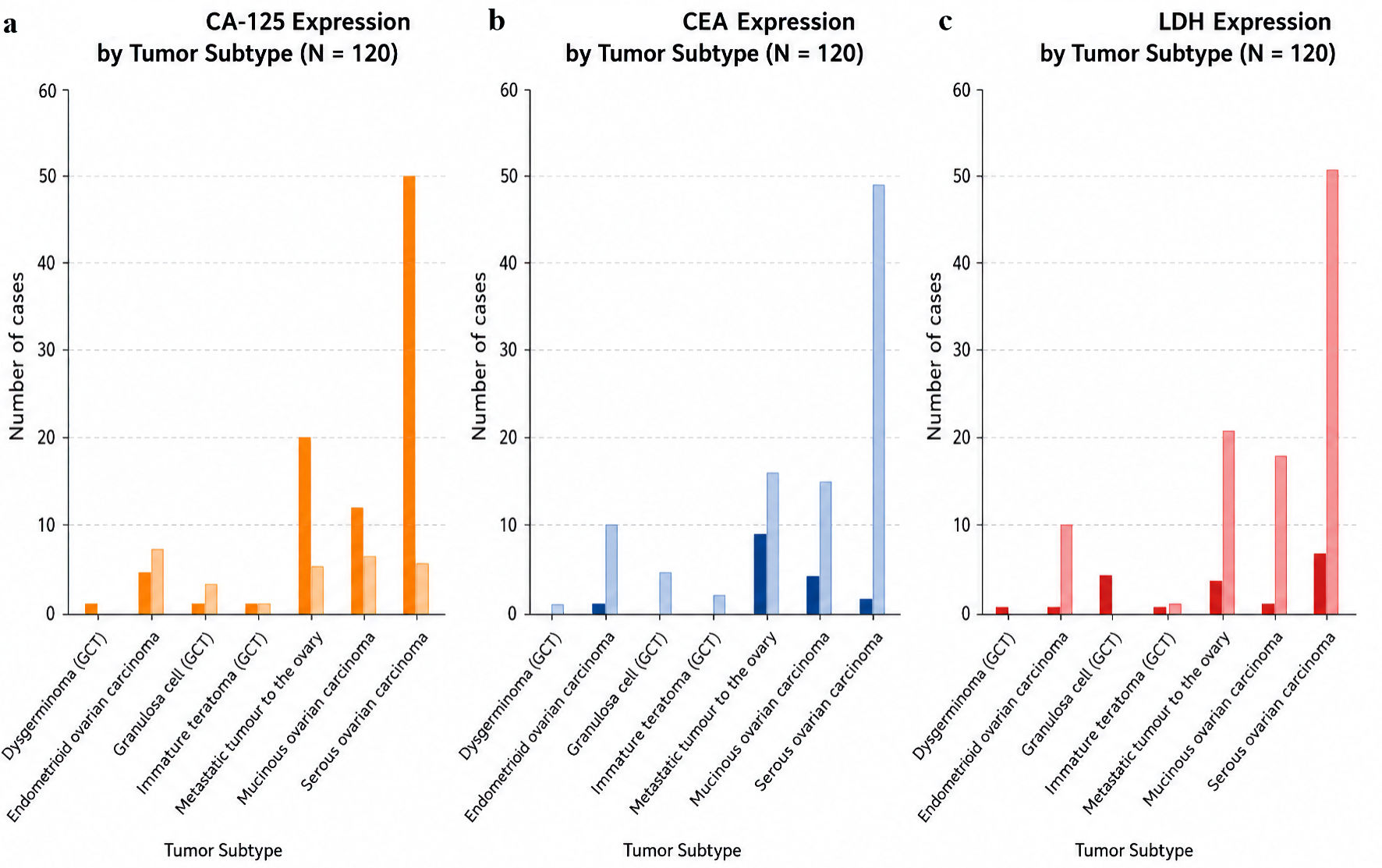
Background: Ovarian cancer remains a highly lethal gynecological malignancy with heterogeneous clinical outcomes. Reliable pretreatment biomarkers are needed to improve prognostic stratification. This study aimed to evaluate variations in pretreatment serum cancer antigen 125 (CA-125), carcinoembryonic antigen (CEA), and lactate dehydrogenase (LDH) across ovarian cancer subtypes and to determine their ability to predict time to recurrence after treatment.
Methods: This retrospective cohort study included adult patients with histologically confirmed ovarian cancer treated with cytoreductive surgery and adjuvant chemotherapy. Pretreatment serum CA-125, CEA, and LDH levels were measured using standardized immunoassays. Biomarker distributions were analyzed by tumor subtype, and time to recurrence after treatment was assessed using Cox proportional hazards regression analysis and Kaplan–Meier analysis.
Results: The study included 126 ovarian cancer patients (mean age 53.17 ± 15.47 years). Serous carcinoma was most common (46%), with most patients presenting at advanced stage IIIb (44.4%) and 57% having high-grade tumors. Elevated pretreatment CA-125 was observed in 76.7%, while CEA and LDH were less frequent (13.3% and 11.7%). Kaplan–Meier analysis showed that elevated CA-125 was associated with a longer time to recurrence after treatment (log-rank P = 0.0057), whereas CEA (P = 0.853) and LDH (P = 0.562) did not show a statistically significant association. In multivariable Cox proportional hazards regression analysis, LDH was independently associated with a shorter time-to-event (hazard ratio (HR), 1.92; 95% CI, 1.03–3.56; P = 0.039), while CEA showed a modest association (HR, 0.50; 95% CI, 0.25–0.98; P = 0.043). CA-125 did not show a statistically significant association (HR, 0.64; P = 0.072). Suboptimal surgery predicted worse outcomes (HR, 4.79; P < 0.001).
Conclusions: Pretreatment serum CA-125 was not independently associated with time to recurrence after adjustment. Elevated LDH was associated with shorter time-to-event, whereas the prognostic significance of CEA remained uncertain and should be interpreted cautiously. Suboptimal surgical cytoreduction remained strongly associated with worse outcomes. These findings suggest LDH may have prognostic relevance, whereas CA-125 and CEA have limited independent value in this cohort.
Published
Issue
Section
License
Copyright (c) 2026 The authors

This work is licensed under a Creative Commons Attribution 4.0 International License.