


A Comparison of Five-Year Survival Rates Between Thermal Ablation and Hepatic Resection for Colorectal Cancer Metastasis to the Liver: A Systematic Review and Meta-Analysis
DOI:
https://doi.org/10.14740/wjon2694Keywords:
Colorectal cancer, Liver metastasis, Thermal ablation, Surgical resection, Five-year survival rate, Meta-analysisAbstract
Background: A significant proportion of colorectal liver metastases (CRLMs) are unresectable. This study compares liver resection with thermal ablation.
Methods: The included studies enrolled patients with either resectable or unresectable tumors, depending on tumor characteristics, institutional protocols, and clinical eligibility. All included studies specifically assessed liver metastases from colorectal adenocarcinoma.
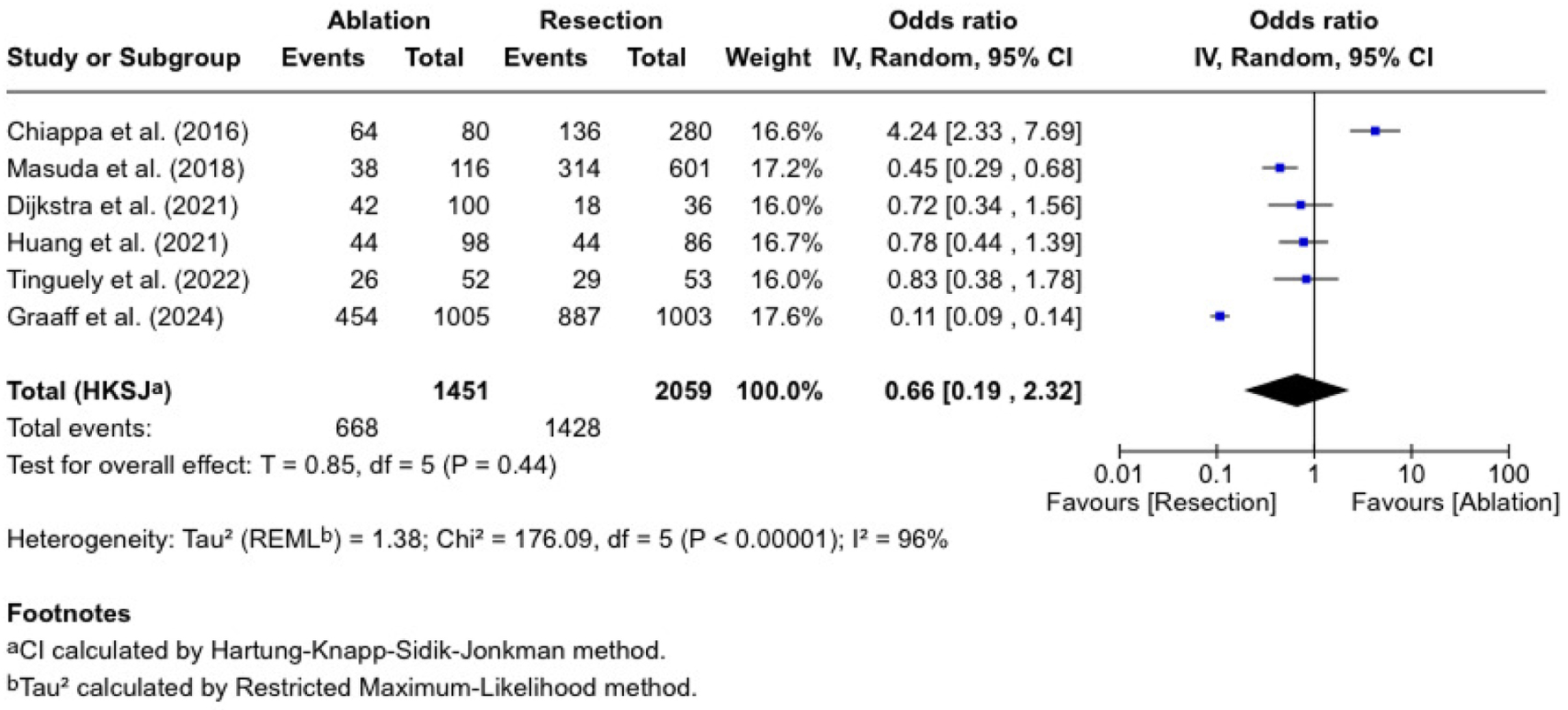
Results: The findings of this review found no significant difference in 5-year overall and disease-free survival rates between both approaches (relative risk (RR) = 0.84 (0.54, 1.30), P = 0.35, I2 = 94%) and (RR = 1.00 (0.32, 3.13), P = 0.99, I2 = 89%), respectively. However, tumor recurrence was higher in the ablation group (odds ratio (OR) = 1.66 (1.06, 2.62), P = 0.03, I2 = 10%). Both groups had similar complication rates (OR = 0.34 (0.09, 1.21), P = 0.08, I2 = 84%). GRADE certainty was very low for all outcomes. The study quality was heterogeneous, and the Newcastle-Ottawa scale (NOS) score ranged from 5 to 9, indicating a moderate to high risk of methodological quality.
Conclusion: The broad heterogeneity of the quality of studies limits the evidence of thermal ablation. Given these uncertainties, hepatic resection is currently the preferred approach.
Published
Issue
Section
License
Copyright (c) 2025 The authors

This work is licensed under a Creative Commons Attribution 4.0 International License.