


Association Between Sleep Disorders and Breast Cancer: An Analysis Based on NHANES and Mendelian Randomization
DOI:
https://doi.org/10.14740/wjon2825Keywords:
Mendelian randomization, National Health and Nutrition Examination Survey, Sleep disorders, Breast cancerAbstract
Background: This study aimed to assess the association between sleep disorders and breast cancer (BC) in the National Health and Nutrition Examination Survey (NHANES) and to evaluate potential causal associations using Mendelian randomization (MR), with separate analyses of estrogen receptor-positive (ER+) and estrogen receptor-negative (ER−) BC.
Methods: This study was based on cross-sectional data from the NHANES 2007–2018, including a total of 8,366 female participants. A weighted multivariable logistic regression model was used to analyze the association between sleep disorders and BC, with stepwise adjustment of covariates. Further subgroup analyses were conducted by covariates. Two-sample MR was applied to evaluate the potential causal association between sleep disorders and BC (including ER+ and ER− subtypes).
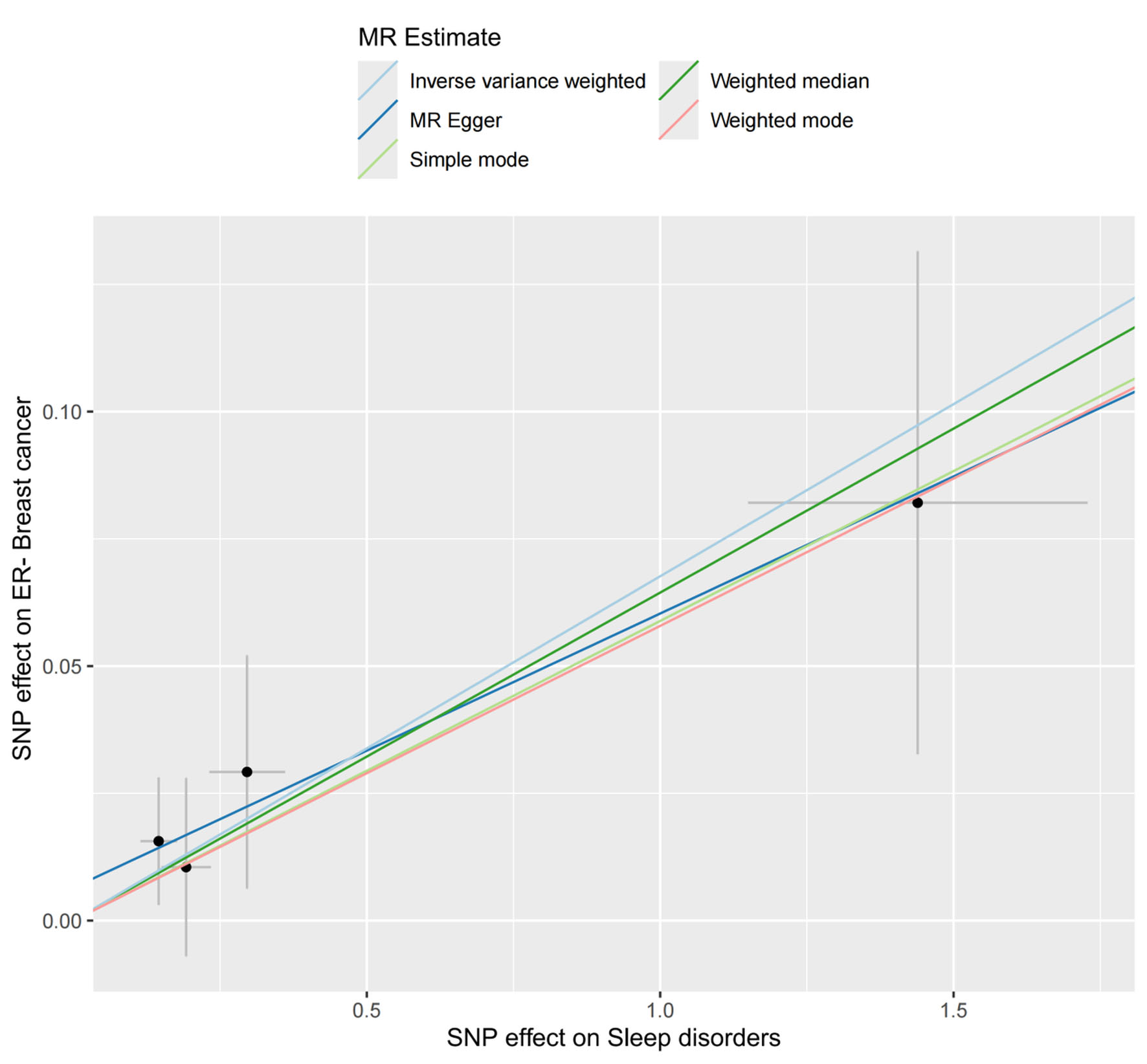
Results: Analysis of NHANES 2007–2018 cross-sectional data showed that among 8,366 female participants, 33.8% of BC patients reported sleep disorders, which was significantly higher than that in the non-cancer group (27.9%, P = 0.035). However, in the weighted logistic regression model with multivariable adjustment, no significant association was observed between sleep disorders and BC risk (model 3: odds ratio (OR) = 0.814, 95% confidence interval (CI): 0.553–1.196, P = 0.298). Subgroup analysis revealed a significant positive correlation between sleep disorders and BC risk in Mexican Americans (OR = 2.801, 95% CI: 1.302–6.025) and participants with low body mass index (BMI) (OR = 2.705, 95% CI: 1.332–5.494), whereas a significant negative correlation was found in diabetic patients (OR = 0.383, 95% CI: 0.199–0.738). Two-sample MR showed no significant causal effect of sleep disorders on ER+ BC risk (inverse variance weighted (IVW) method: OR = 0.98, 95% CI: 0.94–1.02, P = 0.304). For ER− BC, IVW showed a modest positive association (OR = 1.070, 95% CI 1.013–1.130; P = 0.016), whereas the other MR methods were not statistically significant. No significant bias was detected by heterogeneity test (Cochran’s Q test, P > 0.05) or pleiotropy analysis (MR-Egger intercept test, P = 0.662). Leave-one-out sensitivity analysis and funnel plot further confirmed the robustness and symmetry of the results.
Conclusion: The cross-sectional analysis found no overall association between sleep disorders and BC. MR provided suggestive evidence of a modest association between genetically predicted sleep disorders and ER−, but not ER+, BC; this finding requires cautious interpretation and further validation.
Published
Issue
Section
License
Copyright (c) 2026 The authors

This work is licensed under a Creative Commons Attribution 4.0 International License.