


Metastatic Triple-Negative Male Breast Carcinoma of Occult Primary With Axillary Nodal and Cutaneous Metastases
DOI:
https://doi.org/10.14740/wjon2844Keywords:
Occult male breast cancer, Triple-negative breast cancer, Axillary lymph node metastasis, Cutaneous metastasisAbstract
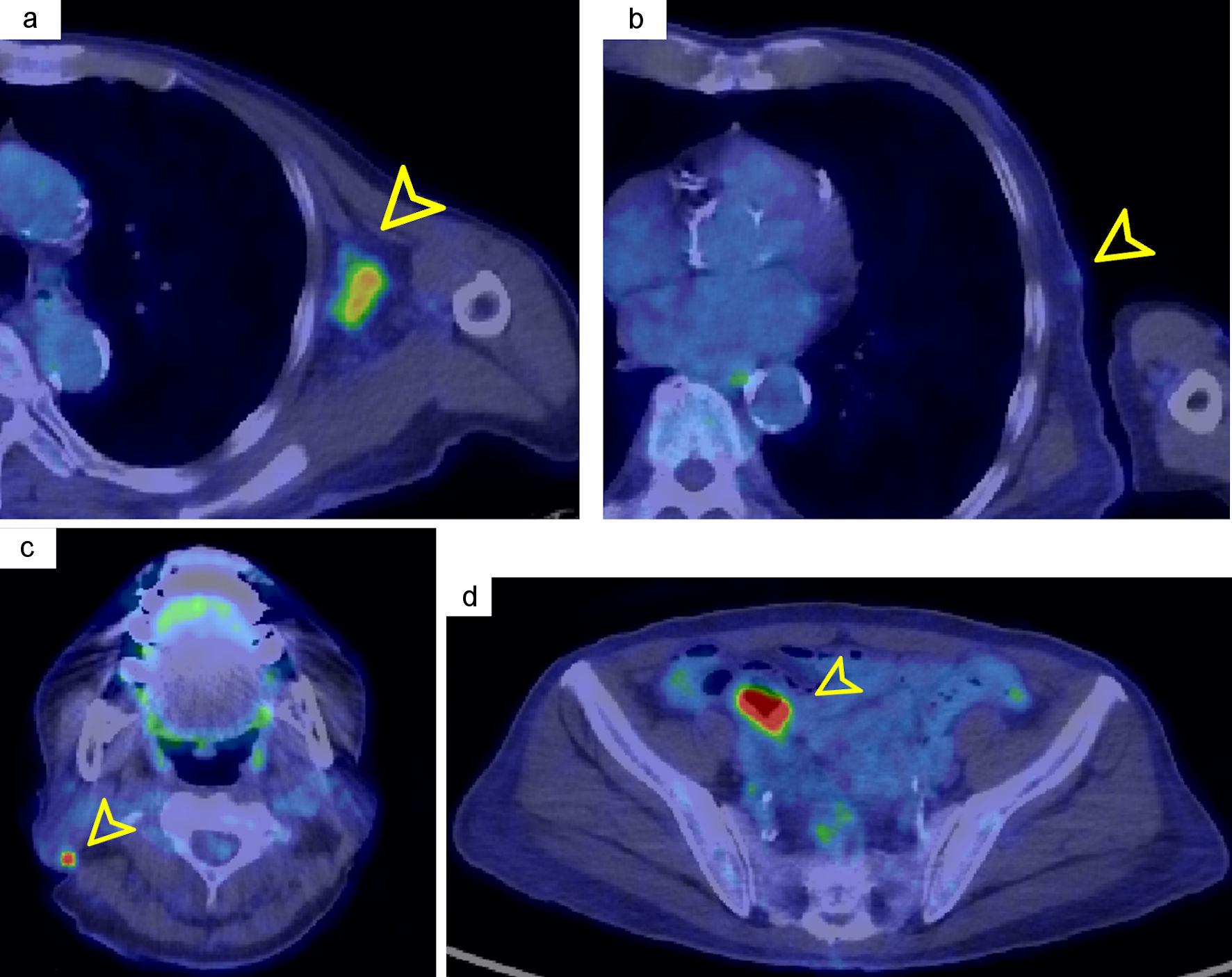
Classical occult breast cancer (OBC), defined as T0N+M0 breast cancer presenting with axillary lymph node metastasis without an identifiable primary breast lesion, is exceptionally rare in men. A 77-year-old man was admitted to the emergency department with hypothermia, and contrast-enhanced computed tomography performed during the initial evaluation revealed enlarged left axillary lymph nodes and cutaneous nodules on the left chest wall. No obvious primary lesion was identified. Because malignant lymphoma or metastasis from another primary malignancy was initially suspected, biopsy of a cutaneous nodule was performed. Histopathological examination demonstrated infiltration of atypical carcinoma cells from the dermis to the subcutaneous tissue. Immunohistochemical analysis was consistent with a mammary origin. Estrogen and progesterone receptors were negative, and human epidermal growth factor receptor 2 expression was negative by fluorescence in situ hybridization, consistent with a triple-negative subtype. Further diagnostic workup identified no primary breast or other malignancy. Axillary lymph node dissection was performed for diagnostic confirmation and regional disease control. The dissected lymph nodes showed tumor morphology and immunophenotype similar to those of the cutaneous lesion, further supporting a diagnosis of mammary origin. The multiple cutaneous lesions were clinically interpreted as metastases; accordingly, the disease was classified as cT0N1M1, stage IV. Germline BRCA1/2 testing revealed no pathogenic variants. The patient was diagnosed with metastatic triple-negative breast carcinoma of occult primary with axillary nodal and cutaneous involvement. Because programmed death-ligand 1 (PD-L1) expression was positive, systemic therapy with pembrolizumab, gemcitabine, and carboplatin was initiated. The clinical course after treatment initiation was initially stable; however, the patient developed recurrent severe hypothermia after the second cycle and died approximately 6 months after the initial presentation. The precise cause of the terminal event remained undetermined, and an immune-related endocrine adverse event could not be excluded because thyroid and pituitary-adrenal function were not evaluated at the terminal admission. This case highlights the importance of comprehensive immunohistochemical evaluation in diagnosing metastatic breast carcinoma of occult primary when no primary breast lesion is detected by imaging. It also highlights the feasibility of PD-L1 testing and combined positive score (CPS)-guided treatment selection in metastatic triple-negative breast carcinoma of occult primary.
Published
Issue
Section
License
Copyright (c) 2026 The authors

This work is licensed under a Creative Commons Attribution 4.0 International License.