| World Journal of Oncology, ISSN 1920-4531 print, 1920-454X online, Open Access |
| Article copyright, the authors; Journal compilation copyright, World J Oncol and Elmer Press Inc |
| Journal website https://wjon.elmerpub.com |
Original Article
Volume 000, Number 000, September 2026, pages 000-000

Socioeconomic Changes During Cancer Therapy and Their Associations With Functional Decline and Treatment Delivery: A Multicenter Prospective Study
Jacqueline Najjara, i  , Nadeen Zayourb, i , Bassam Matara, c, j , Elie Daibessa, d , Elie Jean Karama , Zeinab Hammoude , Solay Farhate , Ghadir M. Nasreddinea , Mohamad Ali Hachema, d , Mohamad Abbassa , Zeinab Sleimana, Issam Chehadef , Maroun Sadekg , Ahmad Ibrahimh
aDepartment of Internal Medicine, Division of Hematology and Oncology, Faculty of Medical Sciences, Lebanese University, PO Box 14-6573, Beirut, Lebanon
bOrganized Research Unit, Al Zahraa Hospital University Medical Center, PO Box 90-361, Beirut, Lebanon
cDepartment of Hematology and Oncology, Al Zahraa Hospital University Medical Center, PO Box 90-361, Beirut, Lebanon
dInternational Department, Gustave Roussy Cancer Campus, 94800 Villejuif, France
eInternal Medicine Department, Faculty of Medical Sciences, Lebanese University, PO Box 14-6573, Beirut, Lebanon
fDepartment of Hematology and Oncology, Rafik Hariri Hospital, Beirut, Lebanon
gDepartment of Hematology and Oncology, Lebanese Hospital Geitaoui-University Medical Center, Beirut, Lebanon
hDepartment of Hematology and Oncology, Makassed General Hospital, PO Box 11-6301, Beirut, Lebanon
iThese authors contributed equally to this work and share first authorship.
jCorresponding Author: Bassam Matar, Department of Internal Medicine, Division of Hematology and Oncology, Faculty of Medical Sciences, Lebanese University, Beirut, Lebanon
Manuscript submitted July 12, 2026, accepted September 1, 2026, published online September 15, 2026
Short title: Socioeconomic Change and Cancer Care
doi: https://doi.org/10.14740/wjon2848
| Abstract | ▴Top |
Background: Socioeconomic instability may affect cancer treatment delivery, yet prospective data on how changes in socioeconomic conditions influence treatment remain limited, particularly in crisis-affected settings. This study evaluated whether socioeconomic deterioration during cancer treatment was associated with a decline in Eastern Cooperative Oncology Group (ECOG) performance status, deterioration in treatment receipt, and decreased adherence to National Comprehensive Cancer Network (NCCN) guideline-recommended care among Lebanese patients with cancer.
Methods: This prospective multicenter analytical study was conducted across five oncology centers in Lebanon from June 13, 2024, to October 30, 2025. Lebanese adults receiving hospital-administered cancer treatment were recruited and assessed at two time points. Baseline and follow-up socioeconomic, household, insurance, payment, clinical, and treatment data were collected via standardized forms. Logistic regression analyses were performed to evaluate associations between socioeconomic deterioration indicators and three outcomes: ECOG performance decline, NCCN compliance decline, and deterioration in treatment receipt.
Results: Among the 244 patients included in the final analysis, 14.3% experienced job loss, 39.3% had decreased household income, 21.3% lost their fixed household income source, 6.1% lost medical insurance, 6.6% had reduced insurance coverage, and 19.7% experienced deterioration in the treatment payment method. ECOG performance declined in 33.2% of patients, NCCN compliance declined in 20.5%, and treatment dose reduction or incomplete treatment occurred in 41.8% of patients. ECOG decline was associated with a greater number of elderly household members and job loss. Deterioration in treatment receipt was associated with loss of health insurance and change in payment method, whereas decline in NCCN compliance was not associated with any of the studied factors.
Conclusions: Socioeconomic deterioration during active cancer treatment was associated with functional decline and deterioration in treatment receipt. These findings support the routine monitoring of socioeconomic instability throughout cancer treatment to identify patients experiencing socioeconomic deterioration and compromised treatment delivery, particularly in crisis-affected healthcare settings.
Keywords: Socioeconomic barriers; Socioeconomic deterioration; ECOG performance status; Guideline-concordant care; Treatment receipt; Lebanon
| Introduction | ▴Top |
Cancer remains one of the leading causes of death worldwide, accounting for nearly 10 million deaths in 2022, with a substantial proportion of the global cancer burden occurring in low- and middle-income countries [1]. Optimal cancer outcomes depend not only on advances in anticancer therapies but also on timely access to care, continuity of treatment, and adherence to evidence-based clinical guidelines. Interruptions, dose reductions, and deviations from recommended treatment plans may compromise treatment effectiveness and survival across various cancer types and treatment modalities [2–4]. In low- and middle-income countries and other resource-constrained healthcare settings, these challenges may be exacerbated by health-system limitations, inadequate insurance coverage, treatment availability constraints, and disruptions in care delivery [5, 6].
In addition to tumor-related and clinical factors, socioeconomic conditions are increasingly recognized as important determinants of cancer care delivery and outcomes [7]. Employment status, household economic stability, health insurance status and coverage adequacy, and living conditions may influence a patient’s ability to access and sustain recommended treatment. Prior evidence, primarily from high-income settings, has shown that socioeconomic disadvantage can create barriers across multiple stages of cancer care, including access to treatment, continuity of care, and completion of prescribed therapy [8, 9]. Importantly, these factors are not static and may change substantially throughout the course of cancer therapy. Patients may experience job loss and increased financial dependence on family members, leading to household economic instability. Concurrently, prolonged or intensive use of health insurance benefits may result in coverage restrictions or benefit exhaustion, limiting their capacity to meet healthcare-related costs. Most studies have assessed socioeconomic status at a single time point or focused on its impact on specific cancer types, providing limited insight into how changes in socioeconomic circumstances during treatment influence treatment delivery, guideline adherence, and clinical outcomes [10–13]. Understanding the dynamic nature of socioeconomic conditions may therefore be essential for identifying patients at increased risk of treatment disruption and adverse outcomes.
Lebanon provides a particularly relevant setting in which to investigate these associations. Since 2019, access to healthcare services and essential medications has been severely constrained by a prolonged national economic crisis, which has also affected employment stability, household economic security, and insurance privileges [14–16]. These challenges have occurred alongside recurrent political instability and, more recently, conflict-related displacement and changes in household living conditions [17]. For patients receiving active cancer treatment, such disruptions may interfere with treatment continuity, access to recommended therapies, and adherence to guideline-concordant care [17, 18]. Although socioeconomic factors have been associated with disparities in cancer treatment and outcomes [7], prospective evidence evaluating how changes in socioeconomic circumstances during active treatment influence functional decline, treatment delivery, and adherence to guideline-recommended care remains limited, particularly in low- and middle-income countries such as Lebanon.
Therefore, this study aimed to prospectively evaluate changes in socioeconomic status, healthcare access, and living conditions during active cancer treatment and to determine whether deterioration in these factors was associated with declines in Eastern Cooperative Oncology Group (ECOG) performance status, deterioration in treatment receipt or regimen completion, and decreased adherence to National Comprehensive Cancer Network (NCCN) guideline-concordant treatment recommendations among Lebanese patients with cancer.
| Materials and Methods | ▴Top |
Study design and setting
This was a multicenter prospective analytical study conducted over a 16-month period, from June 13, 2024, to October 30, 2025. The study was carried out across five oncology centers in Lebanon: Al Zahraa Hospital University Medical Center, Lebanese Geitaoui Hospital, Makassed General Hospital, Rafik Hariri University Hospital, and Saint George Hospital University Medical Center.
The data were collected at two predefined time points: the baseline assessment (T0) and the follow-up assessment (T1). The baseline assessment (T0) was conducted at study enrollment during a hospital-administered anticancer treatment visit and included the collection of demographic, socioeconomic, insurance-related, cancer-related, treatment-related, and NCCN guideline adherence data [19]. The follow-up assessment (T1) was conducted after four cycles since the start of the hospital-administered treatment course. During this follow-up assessment, changes in household composition, employment and income status, medical insurance coverage, ECOG performance status, treatment characteristics, and NCCN guideline adherence were reassessed.
Population and sampling
Participants were eligible if they were Lebanese adults aged 18 years or older, of any gender, had a diagnosis of cancer, and received active anticancer treatment at one of the participating study centers. To enable longitudinal follow-up and reassessment of study outcomes, only patients whose planned treatment course included at least four hospital-administered treatment sessions were eligible for inclusion. This criterion allowed adequate monitoring of treatment delivery over time and repeated assessment of adherence to NCCN guideline-recommended care during active treatment. The recruitment period was designed to allow sufficient time for completion of the four-cycle follow-up assessment among the enrolled participants.
Patients were excluded if they were pregnant at the time in the case of females, were diagnosed with hairy cell leukemia, were receiving treatment exclusively with oral anticancer medications, were undergoing radiotherapy without concurrent systemic therapy, or had a planned treatment course involving fewer than four hospital-administered treatment sessions. Patients who declined participation, had disease progression, or did not meet the eligibility criteria were not enrolled.
Participants who did not complete the T1 assessment were excluded from longitudinal analyses, as the primary outcomes required comparison between T0 and T1. The reasons for this exclusion included treatment plan modification to fewer than four hospital-administered treatment sessions, the discontinuation of active anticancer treatment by the treating physician and the transition to oral therapy or palliative care, or the discontinuation of treatment because of disease- or treatment-related complications (n = 9). Additional reasons for failure to complete follow-up included death, transfer to a nonparticipating hospital, and loss to follow-up. No further assessments were performed for these participants. The participant selection process and reasons for exclusion and noncompletion are summarized in Figure 1.
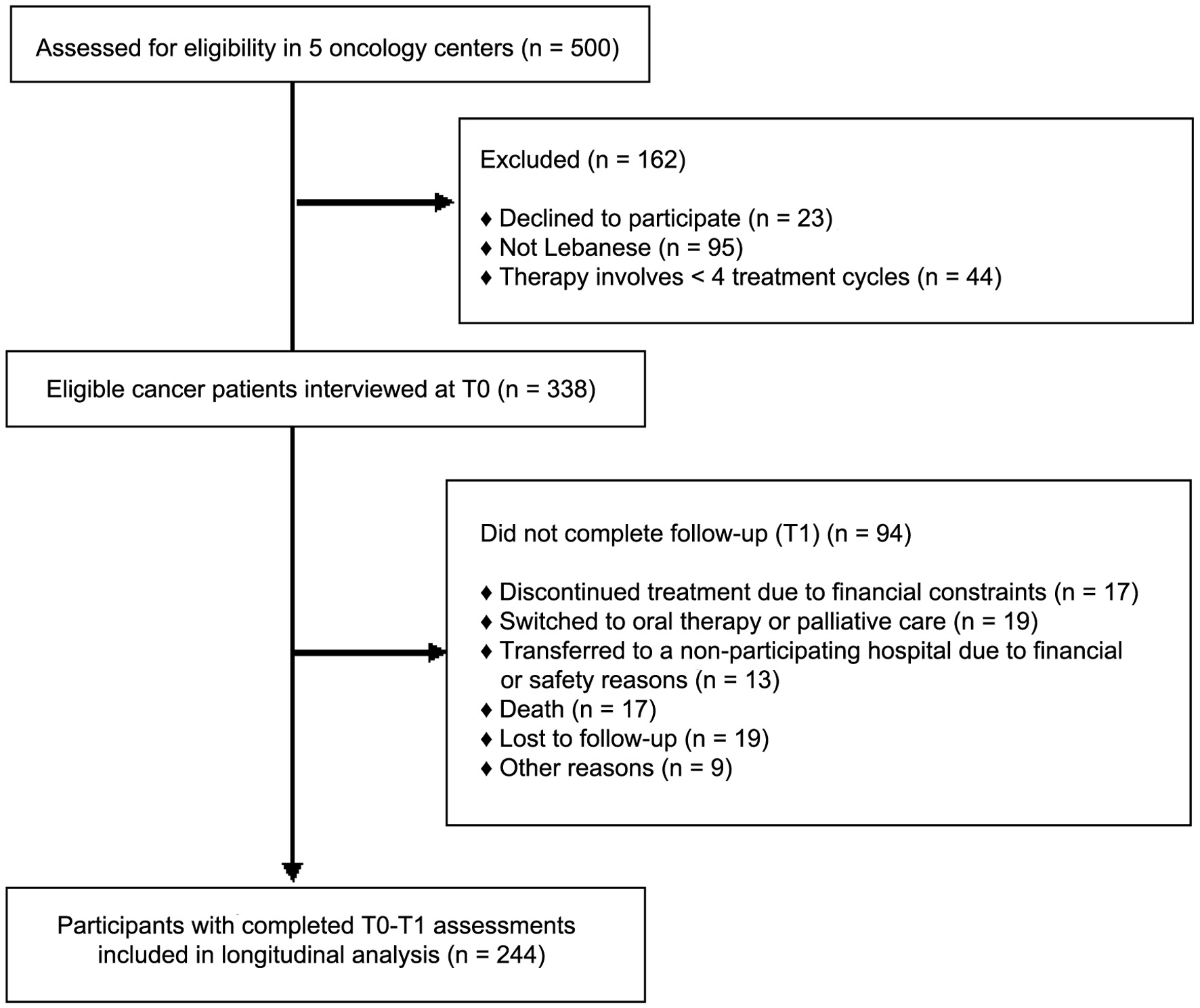 Click for large image | Figure 1. Study flowchart of participant recruitment and follow-up. T0: baseline assessment; T1: follow-up assessment. |
Variables
The study assessed demographic, clinical, socioeconomic, household, insurance-related, and treatment-related variables at baseline and follow-up. Changes in key socioeconomic and insurance-related indicators between T0 and T1 were evaluated as exposure variables, whereas treatment-related outcomes were assessed at follow-up. For instance, the mean delta children number represents the mean change in the number of children between baseline (T0) and follow-up (T1). The three primary outcomes were a decline in ECOG performance status, a decline in NCCN guideline compliance, and deterioration in treatment receipt between baseline (T0) and follow-up (T1). Adherence to NCCN guideline-recommended care was assessed by trained oncology investigators according to the NCCN Clinical Practice Guidelines in Oncology applicable during the 2024–2025 study period. Concordance was determined by comparing each patient’s documented treatment regimen with the applicable NCCN recommendation based on the patient’s cancer type, treatment line, clinical condition, and prescribed treatment regimen. At both T0 and T1, treatment was classified as guideline-concordant or discordant. Cases for which concordance was uncertain were reviewed by the principal investigator (B.M.) for final determination. A formal inter-rater reliability assessment was not performed. Detailed operational definitions and categorizations of all the study variables are provided in Table 1.
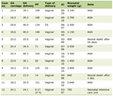 Click to view | Table 1. Definition of T0 and T1 Changes |
Data sources
Data were collected by trained oncology investigators, all of whom were oncology fellows involved in the participating centers, using standardized baseline and follow-up case report forms. Sociodemographic and household-related variables were obtained through patient interviews. Clinical variables, cancer characteristics, ECOG performance status, treatment regimen, treatment receipt, and NCCN guideline adherence were assessed via the medical records, treatment prescriptions, and clinical evaluations.
Bias control
Several measures were implemented to minimize potential sources of bias. The same study protocol and standardized data collection procedures were implemented across all participating centers. Standardized training and simulation sessions were conducted by N.Z. for all data collectors before study initiation to reduce interviewer bias and ensure consistency across centers. Standardized T0 and T1 assessment forms, with structured wording and administration procedures, were used for all participants. To reduce recall and information bias, patient-reported data were verified against available clinical records, treatment prescriptions, and physician documentation whenever possible, including time since diagnosis, interval between diagnosis and treatment initiation, treatment modality, and treatment dosage. ECOG performance status and NCCN guideline adherence were assessed by trained oncology investigators using predefined criteria rather than relying solely on patient self-reports. To minimize potential bias, patients were excluded if ECOG performance status declined due to disease progression, ensuring that any observed ECOG decline was not attributable to worsening disease status. To minimize loss to follow-up, participants were contacted at their scheduled reassessment time, and follow-up assessments were coordinated with routine treatment visits whenever feasible.
Sample size
A consecutive convenience sampling approach was used. No a priori sample size calculation was performed, as all eligible patients presenting to the five participating oncology centers during the study period were invited to participate. During the recruitment period, 500 patients were assessed for eligibility, of whom 338 completed the baseline assessment (T0). Of these, 244 completed the follow-up assessment (T1) and were included in the final analysis (Fig. 1).
Ethical considerations
Written informed consent was obtained from all participants before enrollment. The study was conducted in accordance with the ethical principles of the Declaration of Helsinki and was approved by the institutional review boards of all participating centers: Al Zahraa Hospital University Medical Center (Approval No. 22/2023), Lebanese Geitaoui Hospital (Approval No. 2024-IRB-03), Makassed General Hospital (Approval No. 230124), Rafik Hariri University Hospital (Approval No. 2024-0205), and Saint George Hospital University Medical Center (Approval No. IRB-REC/O/013-25/0925). Participation was voluntary, and participants were informed of their right to withdraw from the study at any time without affecting their medical care. Participant confidentiality and privacy were maintained throughout the study by de-identifying the study data and restricting access to authorized study personnel.
Statistical methods
Analyses were conducted using complete-case data. No imputation was performed for missing values. Initial descriptive statistics were used to summarize the patient cohort at T0. Continuous variables, such as household-size indicators, are presented as the means and standard deviations (SDs). Categorical variables, including gender, educational level, cancer type, and cancer stage, are expressed as frequencies and percentages.
Socioeconomic and healthcare access indicators were assessed at two time points, T0 and T1. To quantify changes between the two time points, binary change variables were created to represent deterioration between the baseline and follow-up assessments. For each socioeconomic or healthcare access indicator, participants were categorized according to whether their status worsened or did not worsen between T0 and T1. Detailed definitions of the exposure and outcome variables are provided in Table 1.
Unadjusted logistic regression analyses were performed to assess whether worsening socioeconomic and healthcare-access indicators between T0 and T1 were associated with ECOG performance decline, deterioration in treatment receipt, and NCCN compliance decline. Variables were subsequently evaluated via using parsimonious multivariable logistic regression models adjusted for prespecified potential confounders, including age, gender, educational level, and center. Center was included as a categorical fixed-effect covariate to account for systematic differences between the five participating hospitals. Hospital ownership (governmental/private) was not included separately because the governmental category corresponded to a single participating center and was therefore not separable from center. Covariates were selected on the basis of their potential relevance to socioeconomic vulnerability and treatment outcomes. Estimates are reported as odds ratios (ORs) with corresponding 95% confidence intervals (CIs). All analyses were conducted via Stata version 19. A two-sided P-value < 0.05 was considered statistically significant.
| Results | ▴Top |
Sociodemographic characteristics
Table 2 presents the baseline sociodemographic characteristics of the study sample (n = 244). Females constituted the majority of participants (n = 144, 59.0%), whereas males represented 41.0% (n = 100) of the cohort. The largest age group was 60–74 years (n = 113, 46.3%), followed by 45–59 years (n = 64, 26.2%) and 75–90 years (n = 34, 14.0%). Only a small proportion of participants were aged 18–29 years (n = 9, 3.7%). Regarding educational attainment, 41.4% (n = 101) of the participants had completed higher education, whereas 21.3% (n = 52) had secondary education and 18.9% (n = 46) had completed high school. Smaller proportions reported primary education (n = 33, 13.5%) or were illiterate (n = 12, 4.9%). The majority of participants were recruited from private hospitals (n = 221, 90.6%), whereas only 23 participants (9.4%) were from a governmental hospital. Additionally, most participants (n = 193, 79.1%) were receiving outpatient treatment in the 1-day oncology treatment units of the hospitals (Table 2).
Click to view | Table 2. Baseline Sample Characteristics of the Study Participants (n = 244) |
Changes in social and clinical indicators
Table 3 summarizes the changes in social and clinical indicators between baseline (T0) and follow-up (T1) and determines the percentage of decline. The proportion of unemployed participants increased from 56.6% (n = 138) at T0 to 63.1% (n = 154) at T1, whereas employment decreased from 29.5% (n = 72) to 26.6% (n = 65). Overall, 14.3% (n = 35) of the participants lost their jobs during follow-up. Household economic conditions worsened over time. Participants reporting a monthly household income of $200–$500 increased from 32.0% (n = 78) to 41.8% (n = 102), whereas those earning $500–$700 decreased from 21.7% (n = 53) to 19.7% (n = 48). Overall, 39.3% (n = 96) experienced a decrease in monthly household income. The proportion of participants with a fixed income declined from 70.1% (n = 171) to 60.7% (n = 148), while those relying on unfixed income increased from 29.9% (n = 73) to 39.3% (n = 96). A total of 21.3% (n = 52) lost a fixed source of income.
Click to view | Table 3. Changes in Social and Clinical Indicators From Baseline (T0) to Follow-Up (T1) |
Access to medical insurance remained relatively stable, with insurance coverage increasing slightly from 57.0% (n = 139) to 58.6% (n = 143). Nevertheless, 6.1% (n = 15) lost insurance access during the study period. Insurance coverage for both hospital fees and treatment increased from 29.5% (n = 72) to 35.3% (n = 86), whereas coverage limited to hospital fees decreased from 9.0% (n = 22) to 3.3% (n = 8). With respect to treatment payment mechanisms, insurance-supported payments increased from 60.2% (n = 147) to 73.4% (n = 179), whereas assistance-supported payments decreased from 36.5% (n = 89) to 23.8% (n = 58). Cash payments remained relatively stable (65.2% vs. 66.8%). Overall, 19.7% (n = 48) lost access to cash or assistance-based payment support. Conflict-related household disruption was reported in 27.5% (n = 67) of participants who experienced relocation during treatment, whereas 72.5% (n = 177) remained unaffected.
With respect to the decline in clinical outcomes, the ECOG performance status deteriorated in 33.2% (n = 81) of the participants, whereas 66.8% (n = 163) experienced no decline. NCCN non-compliance increased in 20.5% (n = 50) of patients. Overall treatment decline, defined as increased dose reductions or incomplete treatment regimens, was observed in 41.8% (n = 102) of the participants, whereas 58.2% (n = 142) experienced no treatment decline (Table 3).
Bivariate associations of socioeconomic factors with the main study outcomes
Bivariate analyses were performed to identify sociodemographic and systemic factors associated with the three main outcome variables. Age was significantly associated with a decrease in ECOG performance (P = 0.001). Patients aged 60–74 years accounted for the largest proportion of patients with an ECOG decline, representing 66.7% of patients with performance status deterioration. For NCCN compliance decline, the center was the only statistically significant sociodemographic or systemic variable (P < 0.001). The proportion of NCCN compliance decline was greater among patients recruited from center B than among those recruited from other hospitals. Interestingly, the center was not significantly associated with treatment receipt and ECOG grade (P > 0.05, respectively). Age group, gender, and educational level were not significantly associated with NCCN compliance decline or with overall treatment receipt (Table 4).
Click to view | Table 4. Bivariate Associations Between Sociodemographic and Systemic Characteristics With Main Study Outcomes |
Exploring associations of patient clinical decline, treatment deviations, and non-compliance
According to the multivariate and Firth penalized logistic regression models, several socioeconomic deterioration indicators were independently associated with worsening treatment-related outcomes. A greater number of elderly household members was significantly associated with increased odds of deterioration in ECOG (adjusted odds ratio (AOR) 1.66, 95% CI 1.16–2.37; P = 0.005). Patients who experienced changes in their occupational status and lost their jobs also had higher odds of grade deterioration (AOR 2.78, 95% CI 1.27–6.07; P = 0.010). With respect to NCCN adherence, none of the factors were not associated with this outcome (P > 0.05, respectively). For overall treatment decline, worsening medical insurance status was significantly associated factor (AOR 2.39, 95% CI 1.07–5.34; P = 0.034). A decline in payment method was also significantly associated with overall treatment deterioration (AOR 1.30, 95% CI 1.03–1.64; P = 0.027). Other socioeconomic indicators were not significantly associated with overall treatment decline after adjustment (Table 5).
Click to view | Table 5. Unadjusted and Adjusted Logistic Regression Analyses of Factors Associated With ECOG Decline, NCCN Compliance Decline, and Deterioration in Treatment Receipt |
| Discussion | ▴Top |
This multicenter prospective study, which was conducted across five Lebanese hospitals and included 244 patients from across Lebanon, provides updated insights into changes in socioeconomic conditions during active cancer treatment. This study demonstrated that deterioration in socioeconomic conditions was associated with functional decline and compromised treatment delivery. Rather than relying only on baseline socioeconomic status, this study prospectively evaluated patient-level socioeconomic changes over time. The most notable changes included transitions from employment to unemployment, from fixed to unstable household income sources, from insured to uninsured status, from preserved to reduced insurance coverage, and from stable to disrupted household living conditions. These changes likely reflect the progressive financial strain experienced by patients during active cancer treatment, which may worsen over time as treatment-related expenses accumulate. These findings are consistent with previous studies showing that patients with cancer frequently experience substantial socioeconomic deterioration while undergoing continuous treatment [7–9]. The observed socioeconomic deterioration may be particularly pronounced in the Lebanese context, where patients receive treatment during a period marked by prolonged economic instability, healthcare system strain, medication-access challenges, and conflict-related displacement [14–17].
An association between worsening socioeconomic conditions and decreased ECOG performance was observed and is clinically important because functional status influences treatment tolerance, eligibility for systemic therapy, acute care utilization, and mortality [20]. In this study, ECOG deterioration was associated with household and healthcare-access vulnerabilities, including a greater number of elderly household members and job loss. These factors may reflect cumulative socioeconomic and caregiving strain during treatment rather than an isolated baseline disadvantage. For example, caring for elderly household members may increase caregiving responsibilities and financial dependency, whereas loss of employment may reduce household stability and the ability to maintain treatment-related expenses and regular healthcare visits. These findings are supported by Tevaarwerk et al [21], who reported that 58% of patients with metastatic cancer experienced employment changes attributable to their illness. Importantly, the relationship between socioeconomic deterioration and functional decline is likely bidirectional. Progressive disease and treatment-related toxicities, such as fatigue, reduced appetite, and physical deconditioning, may worsen performance status and impair a patient’s ability to work, leading to income loss and greater financial vulnerability. Conversely, worsening socioeconomic conditions may further contribute to functional decline by limiting access to healthcare resources and increasing psychosocial and financial stress [22]. Although this observational study cannot establish causality, these findings suggest that functional decline during cancer treatment may evolve alongside worsening socioeconomic and healthcare-access instability rather than solely reflecting disease progression.
Furthermore, this prospective study demonstrated that deterioration in socioeconomic conditions was associated with compromised treatment delivery, reflected by deterioration in treatment receipt and declining NCCN guideline adherence. The deterioration in treatment receipt was associated with deterioration in insurance status and treatment payment methods. These findings suggest that healthcare-access instability may translate into measurable deviations in cancer care delivery and that disruptions occurring outside of tumor biology itself may influence whether patients receive the intended plan of care. Guideline-concordant treatment has been associated with improved outcomes across several cancer settings, including breast cancer, underscoring the clinical relevance of maintaining adherence to recommended care [23, 24]. In the present study, treatment payments relied on multiple mechanisms, including insurance, governmental or institutional coverage, donations, assistance from relatives, and direct cash payments. Deterioration of these mechanisms during follow-up was associated with both deterioration in treatment receipt. These findings are particularly relevant in Lebanon, where previous studies have described healthcare system strain, medication shortages, financial hardship, and treatment interruptions among patients with cancer during the ongoing national crisis [16–18]. The decline in adherence to NCCN-recommended treatment regimens was not significantly associated with changes in occupational status, income source, insurance coverage, or payment type for cancer treatment. This may suggest that treatment non-concordance was influenced by factors beyond patients’ documented socioeconomic and financial characteristics, such as drug availability, treatment-related clinical considerations, institutional practices, or broader healthcare-system constraints. Importantly, these deviations should not be interpreted solely as patient-level nonadherence but rather as manifestations of healthcare system fragility and socioeconomic barriers that limit access to recommended oncology care. Together, these findings suggest that treatment delivery depends not only on clinical indications but also on patients’ ability to maintain stable healthcare access throughout treatment, supporting the incorporation of dynamic socioeconomic and healthcare-access changes into real-world oncology risk assessment, particularly in crisis-affected and resource-constrained settings [6].
Previous studies have consistently shown that socioeconomic status influences cancer outcomes, including prognosis, screening, and access to treatment [7]. However, most studies have evaluated socioeconomic status at a single time point, and evidence on how socioeconomic changes during treatment affect cancer care delivery remains limited. A recent scoping review, which focused largely on high-income countries, reported that socioeconomic disadvantage compromises treatment access, continuity of care, and treatment completion [8]. In low- and middle-income countries, these disparities are further amplified by health system capacity, insurance structures, the availability of essential therapies, and broader inequities in oncology care [5, 6]. In Lebanon, previous studies have described the impact of the national healthcare crisis and anticancer drug shortages on treatment interruptions and modifications among patients with cancer [17, 18]. By prospectively evaluating changes in socioeconomic and healthcare-access conditions during active treatment, the present study extends this evidence by demonstrating that dynamic socioeconomic deterioration, rather than baseline socioeconomic status alone, is associated with functional decline and deterioration in treatment receipt.
This study has several strengths. First, its prospective multicenter design enabled the assessment of changes in socioeconomic and healthcare-access conditions during active cancer treatment rather than relying solely on baseline socioeconomic status. The participating university hospitals are major oncology centers representing both the private and governmental healthcare sectors that serve patients from across Lebanon, enhancing the diversity and representativeness of the study population. Second, the use of paired assessments allowed the identification of dynamic deterioration in socioeconomic and healthcare-access conditions over time. Third, the study evaluated clinically meaningful oncologic outcomes, including ECOG performance decline, NCCN guideline adherence, and treatment receipt, thereby linking socioeconomic deterioration with both patient functional status and treatment delivery. Finally, the study was conducted in a real-world oncology population during a period of prolonged economic crisis, healthcare system strain, and regional conflict, providing prospective evidence from a crisis-affected middle-income setting where such data remain scarce.
Nevertheless, several limitations should be acknowledged. First, its observational design does not allow causal inference, and the observed associations should therefore be interpreted as relationships rather than evidence of direct causality. Second, although 338 eligible patients were enrolled at baseline, only 244 completed follow-up, introducing the possibility of attrition bias. Patients who died, discontinued treatment, transferred care, switched to oral therapy or palliative care, or were lost to follow-up may have differed systematically from those retained, potentially influencing the magnitude of the observed associations. Third, socioeconomic, household, income, and payment-related variables were obtained through patient interviews and may therefore be subject to recall or reporting bias. However, this risk was minimized through standardized questionnaires, uniform data collection procedures, and verification with clinical records whenever feasible. Fourth, functional status was assessed using ECOG performance status, a widely accepted clinical measure; however, it may not capture more subtle changes in physical functioning or quality of life. Although ECOG assessments were performed by trained oncology investigators using standardized forms, some interrater variability may have occurred, as variability in ECOG performance status assessment among oncology healthcare professionals has been previously described [25]. Fifth, despite adjustment for relevant covariates, residual confounding from unmeasured factors cannot be excluded. Additionally, requiring patients to have completed at least four treatment cycles may have introduced selection bias by excluding individuals who discontinued treatment earlier owing to clinical deterioration, socioeconomic barriers, or other treatment-related challenges. Therefore, the findings may not fully reflect the experiences of patients with the most severe early treatment disruptions. Additionally, center-level differences may have influenced the observed associations. Hospital ownership was not independently modeled because the governmental-hospital category was represented by a single participating center, making ownership inseparable from site. Although center was included as a categorical covariate in the multivariable analyses, the relatively small number of participating centers limited the ability to fully account for clustering and to disentangle institutional effects from individual-level socioeconomic factors. Therefore, the observed associations between socioeconomic changes and ECOG or NCCN compliance decline should not be interpreted independently of potential differences in institutional practices, patient case mix, or resource availability across centers. Finally, although the multicenter design enhances external validity, these findings should be interpreted within the Lebanese healthcare context and may not be directly generalizable to healthcare systems with different financing structures, resource availability, or models of oncology care. Furthermore, because the study included patients receiving hospital-administered systemic therapy, the findings may not be fully applicable to patients treated exclusively with oral anticancer therapy or radiotherapy.
Conclusion
Overall, this study demonstrated that socioeconomic conditions are dynamic throughout active cancer treatment and that deterioration in these conditions is associated with functional decline and deterioration in treatment receipt. Addressing socioeconomic deterioration may be an important component of maintaining treatment continuity and the quality of cancer care, particularly in resource-constrained and crisis-affected settings.
Acknowledgments
The authors sincerely thank all patients who participated in this study, as well as the clinical staff at the participating oncology centers, for their valuable support and cooperation during the conduct of this study.
Financial Disclosure
This study was supported by the Roche Real-World Data/Evidence Award 2023. The study proposal was awarded first place following a competitive review by an independent committee of international experts. The funder, Roche Pharmaceuticals, had no role in the study design; data collection, analysis, or interpretation; manuscript preparation; or the decision to submit the manuscript for publication. The article processing charge was covered by the funder.
Conflict of Interest
The authors declare that they have no conflict of interest.
Informed Consent
Written informed consent was obtained from all participants before enrollment.
Author Contributions
Conceptualization: M.A.H., G.M.N., B.M., N.Z., M.S., A.I., and I.C.; methodology: N.Z., B.M., J.N., G.M.N., Z.H., S.F., M.A., Z.S., M.S., A.I., and I.C.; validation: N.Z., B.M., J.N., E.D., E.J.K., M.A., and Z.S.; formal analysis: N.Z.; investigation: J.N., E.D., E.J.K., S.F., Z.H., G.M.N., N.Z., M.A., Z.S., and M.A.H.; resources: B.M.; data curation: N.Z., J.N., E.D., E.J.K., S.F., and Z.H.; writing—original draft preparation: J.N., N.Z., Z.H., S.F., J.N., E.D., E.J.K., M.A., M.A.H., and Z.S.; writing—review and editing: N.Z., B.M., M.S., A.I., and I.C.; visualization: B.M. and N.Z.; supervision: B.M., M.S., A.I., I.C., and N.Z.; project administration: B.M. and N.Z.; funding acquisition: M.A.H., G.M.N., and B.M. All authors have read and agreed to the published version of the manuscript.
Data Availability
The authors declare that data supporting the findings of this study are available within the article.
Abbreviations
AOR: adjusted odds ratio; CI: confidence interval; ECOG: Eastern Cooperative Oncology Group; NCCN: National Comprehensive Cancer Network; OR: odds ratio; SD: standard deviation; T0: baseline assessment; T1: follow-up assessment
| References | ▴Top |
- Bray F, Laversanne M, Sung H, Ferlay J, Siegel RL, Soerjomataram I, Jemal A. Global cancer statistics 2022: GLOBOCAN estimates of incidence and mortality worldwide for 36 cancers in 185 countries. CA Cancer J Clin. 2024;74(3):229-263.
doi pubmed - Denduluri N, Patt DA, Wang Y, Bhor M, Li X, Favret AM, Morrow PK, et al. Dose delays, dose reductions, and relative dose intensity in patients with cancer who received adjuvant or neoadjuvant chemotherapy in community oncology practices. J Natl Compr Canc Netw. 2015;13(11):1383-1393.
doi pubmed - Hanna TP, King WD, Thibodeau S, Jalink M, Paulin GA, Harvey-Jones E, O'Sullivan DE, et al. Mortality due to cancer treatment delay: systematic review and meta-analysis. BMJ. 2020;371:m4087.
doi pubmed - Nielson CM, Bylsma LC, Fryzek JP, Saad HA, Crawford J. Relative dose intensity of chemotherapy and survival in patients with advanced stage solid tumor cancer: a systematic review and meta-analysis. Oncologist. 2021;26(9):e1609-e1618.
doi pubmed - de Souza JA, Hunt B, Asirwa FC, Adebamowo C, Lopes G. Global health equity: cancer care outcome disparities in high-, middle-, and low-income countries. J Clin Oncol. 2016;34(1):6-13.
doi pubmed - Bamodu OA, Chung CC. Cancer care disparities: overcoming barriers to cancer control in low- and middle-income countries. JCO Glob Oncol. 2024;10:e2300439.
doi pubmed - Li S, He Y, Liu J, Chen K, Yang Y, Tao K, Yang J, et al. An umbrella review of socioeconomic status and cancer. Nat Commun. 2024;15(1):9993.
doi pubmed - Bourgeois A, Horrill T, Mollison A, Stringer E, Lambert LK, Stajduhar K. Barriers to cancer treatment for people experiencing socioeconomic disadvantage in high-income countries: a scoping review. BMC Health Serv Res. 2024;24(1):670.
doi pubmed - Shand J, Stovold E, Goulding L, Cheema K. Cancer care treatment attrition in adults: Measurement approaches and inequities in patient dropout rates - a rapid review. BMC Cancer. 2024;24(1):1345.
doi pubmed - Ehsan AN, Wu CA, Minasian A, Singh T, Bass M, Pace L, Ibbotson GC, et al. Financial toxicity among patients with breast cancer worldwide: a systematic review and meta-analysis. JAMA Netw Open. 2023;6(2):e2255388.
doi pubmed - Donkers H, Bekkers R, Massuger L, Galaal K. Systematic review on socioeconomic deprivation and survival in endometrial cancer. Cancer Causes Control. 2019;30(9):1013-1022.
doi pubmed - Tham NL, Skandarajah A, Hayes IP. Socioeconomic disadvantage and its impact on colorectal cancer in Australia: a scoping review. ANZ J Surg. 2022;92(11):2808-2815.
doi pubmed - Zouzoulas D, Karalis T, Sofianou I, Anthoulakis C, Tzika K, Zafrakas M, Timotheadou E, et al. The impact of treatment delay on endometrial and ovarian cancer patients: a systematic review. Cancers (Basel). 2025;17(13):2076.
doi pubmed - Fleifel M, Abi Farraj K. The Lebanese Healthcare Crisis: An Infinite Calamity. Cureus. 2022;14(5):e25367.
doi pubmed - Yamout R, Khalil J, Raven J, Fouad FM, Mansour W. Navigating turbulence: analyzing the resilience of Lebanon's healthcare system in a multi-crisis scenario. Health Res Policy Syst. 2025;23(1):120.
doi pubmed - Khalife J, Rady A, Shoaib H, Harb A, Harb H, Hamra R, Ammar W. Bridging crisis recovery and long-term transformation of the health system in Lebanon: evidence from key informant interviews and global lessons. BMC Health Serv Res. 2026;26(1):828.
doi pubmed - Azzi A, El Assaad N, Haddad E, Chehata N, Choucair J, Saliba G. Healing under fire: the challenges facing Lebanon's health care amid war. Disaster Med Public Health Prep. 2025;19:e147.
doi pubmed - Kattan C, Kattan J. Accommodation with anticancer drug shortage: a Lebanese harmful solution. Front Oncol. 2022;12:1055113.
doi pubmed - National Comprehensive Cancer Network (NCCN). NCCN Clinical Practice Guidelines in Oncology. Available online: https://www.nccn.org/guidelines/nccn-guidelines (accessed on May 16, 2026).
- Kumar D, Neeman E, Zhu S, Sun H, Kotak D, Liu R. Revisiting the association of ECOG performance status with clinical outcomes in diverse patients with cancer. J Natl Compr Canc Netw. 2024;22(2 D):e237111.
doi pubmed - Tevaarwerk AJ, Lee JW, Terhaar A, Sesto ME, Smith ML, Cleeland CS, Fisch MJ. Working after a metastatic cancer diagnosis: factors affecting employment in the metastatic setting from ECOG-ACRIN's Symptom Outcomes and Practice Patterns study. Cancer. 2016;122(3):438-446.
doi pubmed - Janmunee N, Peerawong T, Phenwan T, Supanichwatana S, Kongkamol C. Factors influencing job retention and quality of life amongst nasopharyngeal carcinoma patients. Asian Pac J Cancer Prev. 2021;22(5):1401-1406.
doi pubmed - Rocque GB, Williams CP, Kenzik KM, Jackson BE, Azuero A, Halilova KI, Ingram SA, et al. Concordance with NCCN treatment guidelines: relations with health care utilization, cost, and mortality in breast cancer patients with secondary metastasis. Cancer. 2018;124(21):4231-4240.
doi pubmed - Herbach EL, Carnahan RM, McCullough LE, McDowell BD, Curran M, Wang K, Lizarraga IM, et al. Guideline-concordance along the cancer care continuum and breast cancer mortality by race and ethnicity: a SEER-Medicare study. Cancer Causes Control. 2026;37(2):33.
doi pubmed - Azam F, Latif MF, Farooq A, Tirmazy SH, AlShahrani S, Bashir S, Bukhari N. Performance status assessment by using ECOG (Eastern Cooperative Oncology Group) score for cancer patients by oncology healthcare professionals. Case Rep Oncol. 2019;12(3):728-736.
doi pubmed
This article is distributed under the terms of the Creative Commons Attribution 4.0 International License (CC BY 4.0), which permits unrestricted use, distribution, and reproduction in any medium, including commercial use, provided the original work is properly cited.
World Journal of Oncology is published by Elmer Press Inc.