World Journal of Oncology, ISSN 1920-4531 print, 1920-454X online, Open Access
Article copyright, the authors; Journal compilation copyright, World J Oncol and Elmer Press Inc
Journal website https://wjon.elmerpub.com

Review

Volume 17, Number 3, June 2026, pages 277-291


De-Escalation of Axillary Surgery: A Review of Choosing Wisely Guideline Evidence

Figures

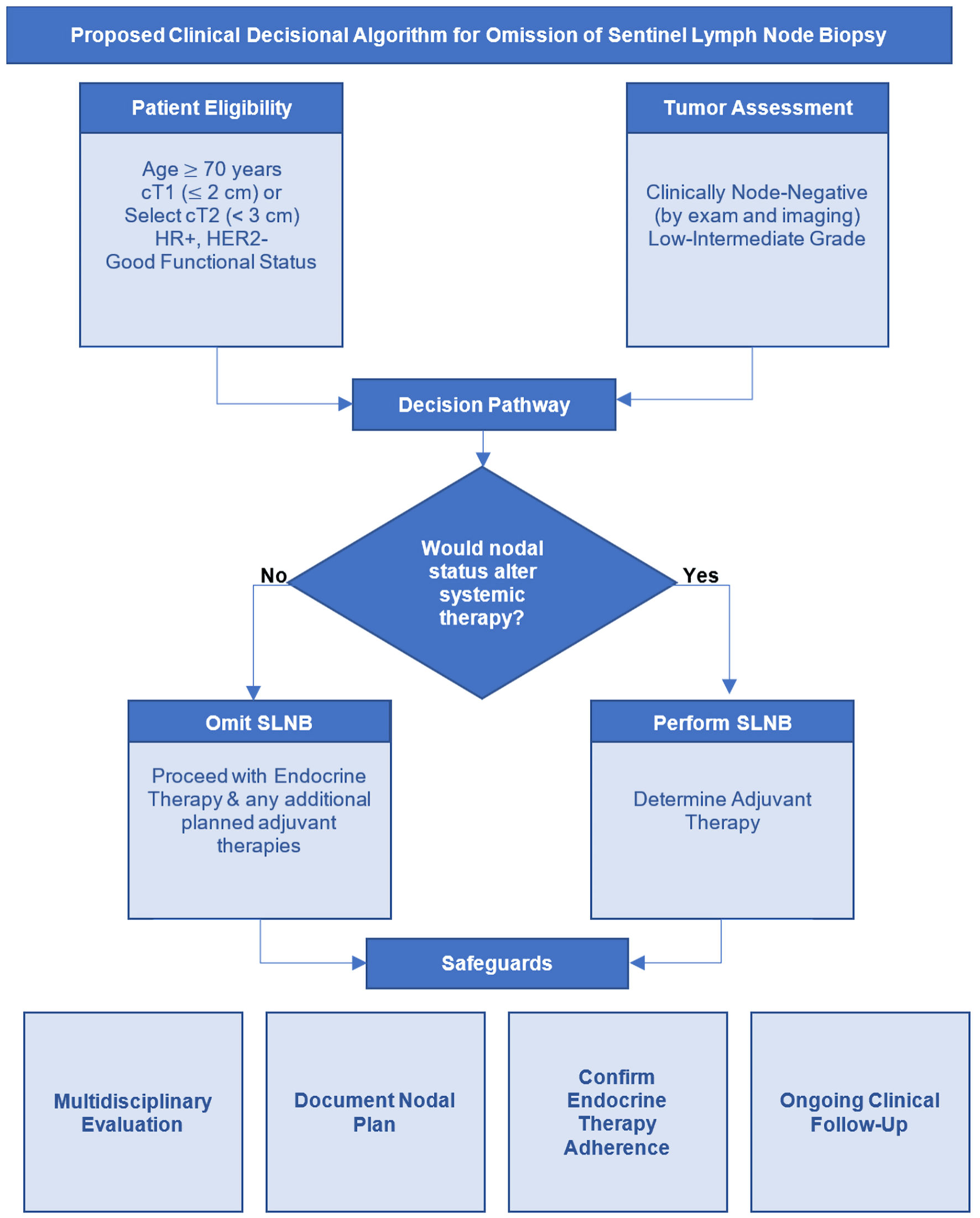
↓  Figure 1. Evolution of axillary management in breast cancer. Axillary surgery has progressively de-escalated from routine axillary lymph node dissection (ALND) toward sentinel lymph node biopsy (SLNB), and more recently, omission of axillary surgery in selected patients. Landmark trials, including NSABP B-04 [15], NSABP B-06 [16], NSABP B-32 [5], IBCSG 23-01 [1], AATRM 048 [6], ACOSOG Z0011 [4], SINODAR-ONE [27], SENOMAC [28], SERC [29], AMAROS [31], OTOASOR [30], CALGB 9343 [8], IBCSG 10-93 [9], Martelli et al (2012) [32], INT09/98 [17], SOUND [33], and INSEMA [34], have established the safety of reducing surgical intervention without compromising oncologic outcomes. BOOG 2013-08 [35], NAUTILUS [36], and OMSLNB [37] trials are ongoing to confirm preliminary findings of SOUND and INSEMA expanding the population of women eligible for omission of axillary surgery. NSABP: National Surgical Adjuvant Breast and Bowel Project; IBCSG: International Breast Cancer Study Group; AMAROS: After Mapping of the Axilla: Radiotherapy or Surgery; OTOASOR: Optimal Treatment of the Axilla- Surgery Or Radiotherapy; SOUND: Sentinel Node vs. Observation After Axillary Ultra-Sound; INSEMA: Intergroup Sentinel Mamma; CALGB: Cancer and Leukemia Group B.
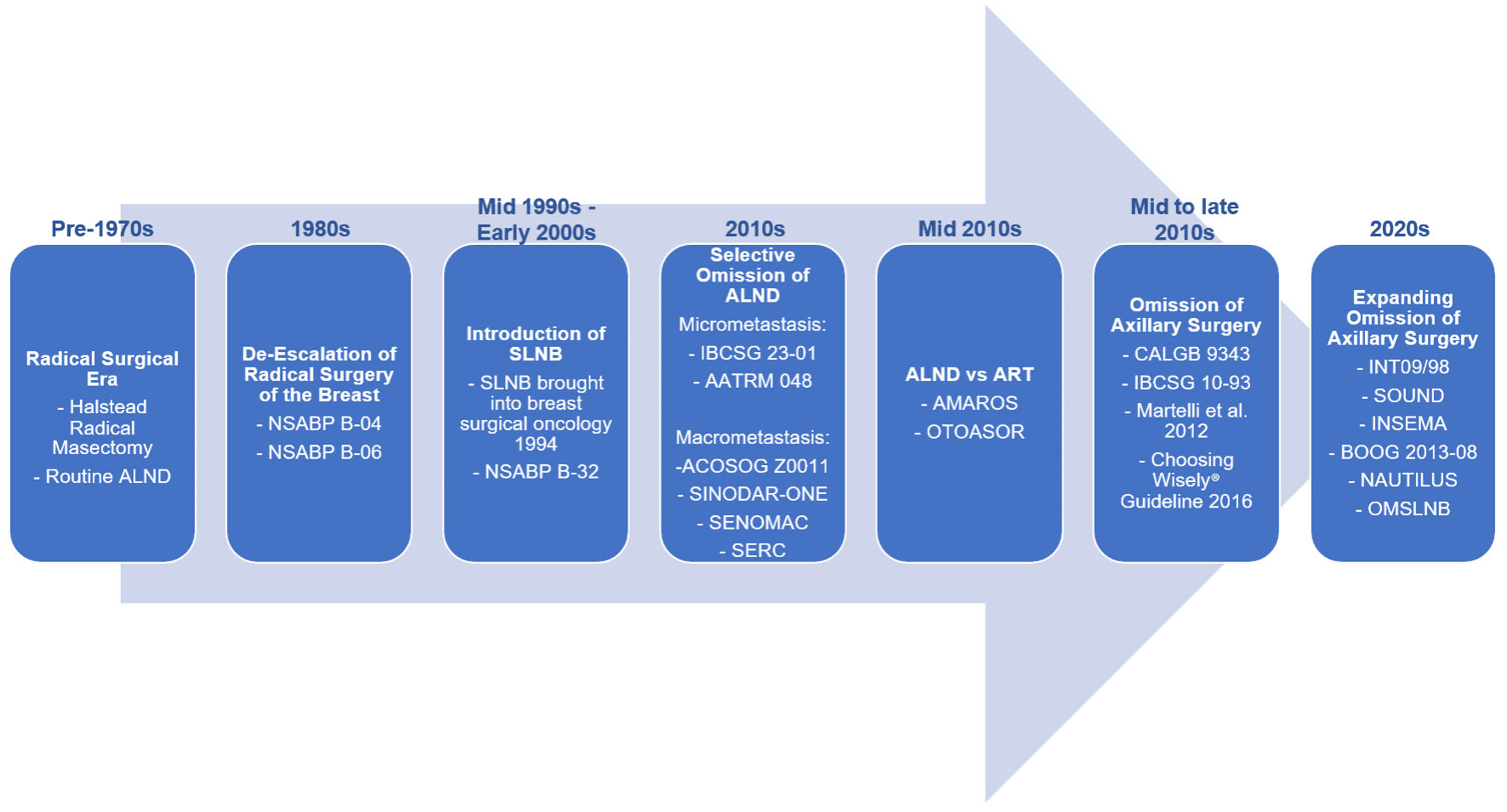
Figure 1.
↓  Figure 2. Clinical decisional algorithm for omission of sentinel lymph node biopsy (SLNB) in early-stage HR-positive, HER2-negative breast cancer. The algorithm outlines a multidisciplinary approach to identify patients, in whom SLNB may be safely omitted. The process begins with confirmation of clinically node-negative status and assessment of tumor biology and overall recurrence risk. The key decision point is whether nodal staging would alter adjuvant systemic or radiation therapy recommendations. In patients with favorable tumor biology, low anticipated benefit from chemotherapy, and a planned course of endocrine therapy, omission of SLNB is appropriate. Additional considerations include physiologic age, comorbidity burden, life expectancy, and treatment tolerance. Safe implementation requires shared decision-making, confirmation of endocrine therapy initiation, and routine clinical follow-up. This framework positions SLNB as a selective staging procedure rather than routine practice, aligning axillary management with contemporary biologically driven treatment paradigms. HR: hormone receptor; HER2: human epidermal growth factor receptor 2.
Figure 2.

Table

↓  Table 1. Current Professional Society Guidelines Supporting Omission of SLNB
 
SSO: the Society of Surgical Oncology; SLNB: sentinel lymph node biopsy; HR: hormone receptor; HER2: human epidermal growth factor receptor 2; SOUND: Sentinel Node vs. Observation After Axillary Ultra-Sound; INSEMA: Intergroup Sentinel Mamma; US: ultrasound.
SSO Choosing Wisely® [11]Avoid routine SLNB in women ≥ 70 years of age with cN0, early stage, HR+, HER2– invasive breast cancer treated with endocrine therapy.
American Society of Breast Surgeons [41]Axillary lymph node staging is not indicated in women ≥ 70 years of age with cT1–2N0 HR+ breast cancer and when it will not affect adjuvant treatment recommendations.
National Comprehensive Cancer Network [42]Axillary staging may be omitted in patients with favorable tumor biology, significant comorbidities, or when adjuvant therapy decisions will not be impacted. Based on SOUND and INSEMA trials, patients > 50 years and postmenopausal with cT1N0 (by axillary US), with HR+/HER2–, grade 1–2 tumors agreeable to receiving whole breast RT and endocrine therapy.